
Stuffy, hot, humid or drafty-space complaints
Habitability & Environmental Quality · SERVICE 15
Ship HVAC and Ventilation Performance Survey
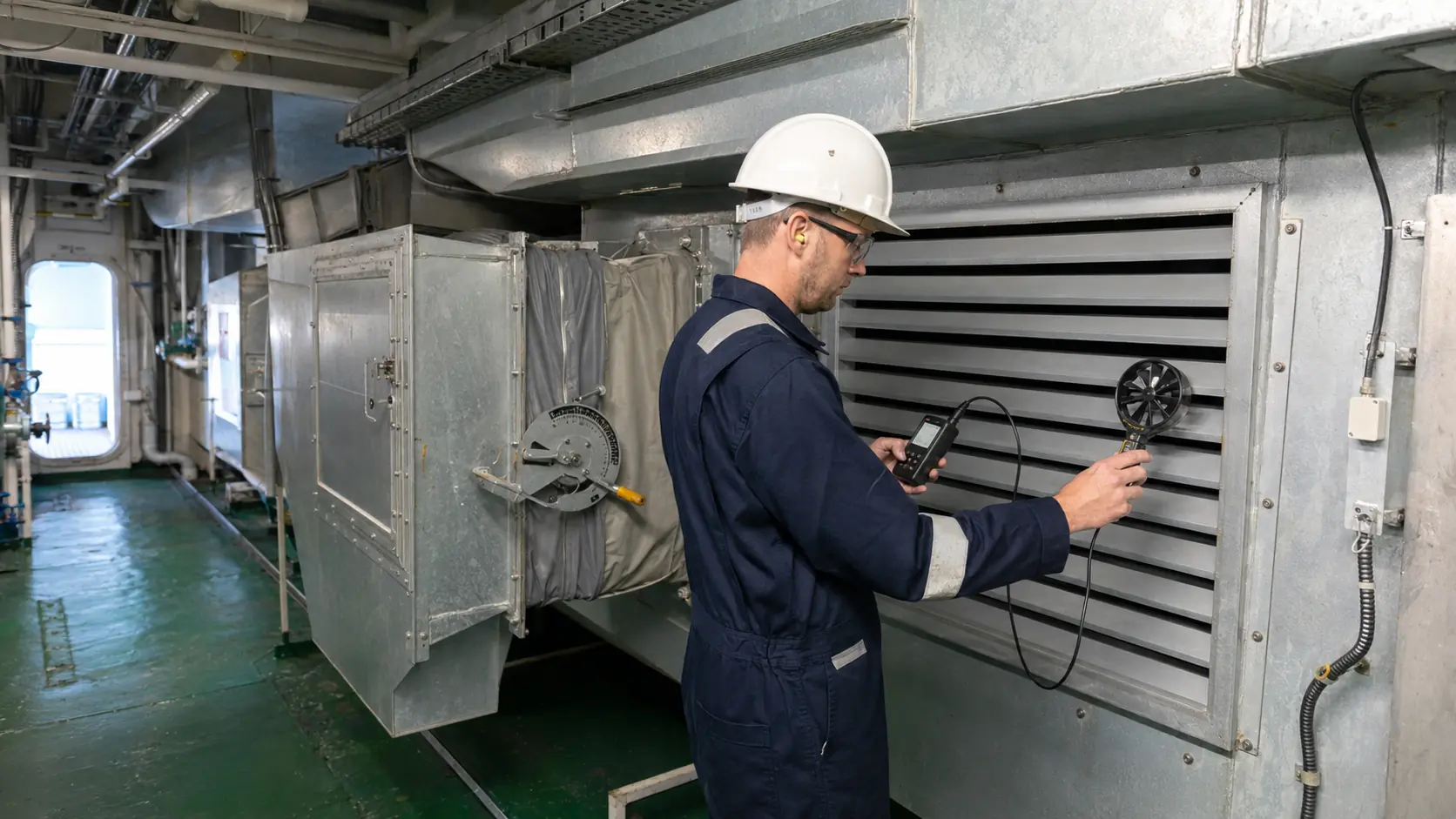
Vessel ventilation must deliver adequate outdoor air, remove heat and contaminants, maintain pressure relationships and provide comfort without creating excessive noise or drafts. Vessel Doctor measures the performance experienced in the space—not only the indication shown at the control panel.
ENVIRONMENTAL QUALITYClear evidence→
VESSEL DOCTORShip HVAC and Ventilation Performance Survey
SURVEY PROFILEHabitability & Environmental Quality
15/21
01
WHY THIS SURVEY MATTERS
Evidence before assumption.
Poor distribution can leave one cabin stuffy while another is overcooled. Blocked filters, incorrect damper positions, fan degradation, leakage and system imbalance may affect air quality, comfort and noise simultaneously.
02
MEASUREMENT SCOPE
What we measure.
- ✓Supply, return and exhaust airflow
- ✓Air velocity at grilles and occupied zones
- ✓Air-change rate where the method permits
- ✓Temperature and humidity across the system
- ✓Pressure relationships between selected spaces
- ✓Carbon-dioxide response as a ventilation indicator
- ✓Ventilation noise and vibration where included
03
TIMING & APPLICATION
When to request it.
Newbuilding HVAC commissioning
After duct, fan, diffuser or accommodation changes
Suspected exhaust or odour transfer
Repeated filter or condensation issues
Combined IAQ, thermal and noise investigation
04
SURVEY PROCESS
A controlled route from plan to finding.
Define
Confirm the decision, vessel condition and evaluation basis.
Prepare
Agree locations, safe access, instruments and operating matrix.
Measure
Capture traceable data with conditions documented during measurement.
Interpret
Evaluate against the agreed basis and isolate meaningful patterns.
Report
Issue findings, limitations and focused next actions.
05
TECHNICAL DELIVERABLE
What you receive.
- ✓System and space measurement schedule
- ✓Airflow and environmental results
- ✓Distribution and imbalance findings
- ✓Pressure/transfer observations
- ✓Probable restrictions or control issues
- ✓Recommendations for testing, adjusting, balancing or maintenance
06
STANDARDS & PROJECT CRITERIA
The governing basis comes first.
Use applicable flag/class rules, vessel design values, MLC-related accommodation requirements where relevant, maker data and recognised ventilation measurement methods. Air-change calculations must state the room volume, measurement basis and assumptions.
Important
Explore our standards directory↗Acceptance remains subject to the applicable flag administration, classification society, contract, vessel specification and authorised reviewing party.
ASIA + WORLDWIDE ATTENDANCE
Ship HVAC and Ventilation Performance Survey wherever the vessel needs it.
Vessel Doctor coordinates this service for vessels in Singapore, India, Malaysia, Sri Lanka, Indonesia, Thailand, wider Asian maritime centres and ports worldwide. The scope can support technical managers, marine superintendents, ship agents, owners, operators, shipyards and consultants who need documented onboard evidence.
How clients describe this need: Projects may be described as ship HVAC performance survey, vessel ventilation testing, onboard airflow measurement, air-change assessment and marine HVAC inspection. Clients may also report that airflow is weak or uneven, cabins feel stuffy, odours transfer between spaces, or the ventilation system is noisy or poorly balanced. Depending on the technical question, the attendance may involve airflow testing, ventilation measurement, monitoring, inspection, balancing assessment, commissioning check or diagnostics during shipyard commissioning, sea trials, delivery acceptance, after duct or fan changes, or while investigating in-service complaints. We confirm the final scope from the vessel, operating condition, access, applicable criteria, measurement purpose and required reporting outcome.
Southeast AsiaShip HVAC and Ventilation Performance Survey in Singapore↗South AsiaShip HVAC and Ventilation Performance Survey in India↗Southeast AsiaShip HVAC and Ventilation Performance Survey in Malaysia↗South AsiaShip HVAC and Ventilation Performance Survey in Sri Lanka↗Southeast AsiaShip HVAC and Ventilation Performance Survey in Indonesia↗Southeast AsiaShip HVAC and Ventilation Performance Survey in Thailand↗Global coverageWorldwide Ship HVAC and Ventilation Performance Survey↗
SERVICE FAQ
Questions project teams ask.
Every scope is confirmed against the actual vessel, timing and decision requirement.
01Is air-change rate the same as outdoor-air rate?+
Not necessarily. Recirculated air may increase total air changes without increasing outdoor air.
02Can you balance the HVAC system?+
Survey and diagnostic measurement can identify imbalance. Full testing, adjusting and balancing should be quoted as a separate scope when required.
03Why combine HVAC testing with IAQ?+
Ventilation performance helps explain carbon dioxide, odour, humidity and contaminant patterns.
04Can ventilation cause noise complaints?+
Yes. High velocity, turbulence, fan vibration, poor attenuator performance and grille selection can create significant noise.
START A TECHNICAL DISCUSSION
Plan your ship hvac and ventilation performance survey.
Share the vessel, location, operating condition and reporting purpose. We will help shape a focused, technically defensible survey scope.
SHIP HVAC DIAGNOSTIC PLAN
Trace airflow from the system to the occupied space.
A ship ventilation performance test must separate total recirculated airflow, outdoor-air delivery, exhaust, transfer and space pressure. Strong fan indication or a high grille velocity does not prove that every cabin receives the required fresh air.
Map the air path
Confirm air-handling unit, fan, outside-air intake, filter, coil, damper, branch, terminal, return, transfer and exhaust serving each affected space.
Freeze the operating matrix
Record fan speed, damper position, filter state, doors, occupancy, weather, machinery, cooling load and simultaneous systems for comparable measurements.
Use the right method
Measure duct or terminal flow, velocity, temperature, humidity and pressure with sufficient traverse or capture coverage for the geometry and reporting purpose.
Find the restriction
Compare design or agreed values, sister spaces and upstream/downstream points to identify filter, damper, leakage, duct, fan, control or distribution problems.
| Observed condition | Diagnostic comparison | Important distinction |
|---|---|---|
| Airflow is weak or uneven between cabins | Terminal flow by space, branch or damper state, fan condition and pressure/velocity comparison across the distribution path. | Face velocity at one point is not automatically the total grille airflow. |
| Cabin feels stuffy despite strong supply air | Outdoor-air fraction or agreed fresh-air basis, recirculation, occupancy/CO₂ response, exhaust and transfer path. | Total air changes can be high while outdoor-air delivery remains inadequate. |
| Odour transfers from toilets, galley, machinery or adjacent spaces | Supply/exhaust balance, differential pressure, door/transfer condition and smoke or tracer assessment where safely agreed. | Pressure direction depends on the whole air balance, not one supply reading. |
| Condensation, humidity or overcooling complaints | Temperature/humidity distribution, coil and control state, airflow, load, outside-air condition and surface risk locations. | Comfort, moisture control and ventilation can require different corrective actions. |
| Commissioning, sea trial or post-retrofit verification | System schedule, design values, calibrated method, room volume, fan/damper configuration, test condition and documented exceptions. | Survey and diagnosis identify imbalance; full testing, adjusting and balancing is a separately agreed work scope. |
Method and submission context
The measurement plan should state instrument calibration, duct or terminal geometry, traverse/capture method, room-volume basis, outdoor versus recirculated air, pressure reference and calculation assumptions. For classed or flagged vessels, confirm design values, notation, maker data, approved drawings, witnessing and report-review requirements with the owner, yard and attending surveyor. General diagnostics and formal acceptance are not automatically the same service, and no class or flag approval is implied.