
Environmental Ship Index noise assessment
Noise & Acoustics · SERVICE 08
NEPTUNES / ESI Airborne Noise Survey for Moored Ships
Vessels at berth can operate auxiliary engines, ventilation systems, pumps, exhausts and refrigerated cargo equipment for extended periods. These sources may affect nearby communities even when onboard occupational noise requirements are satisfied. Vessel Doctor applies the NEPTUNES/ESI measurement approach to quantify the airborne noise performance of moored ships under representative and documented operating conditions.
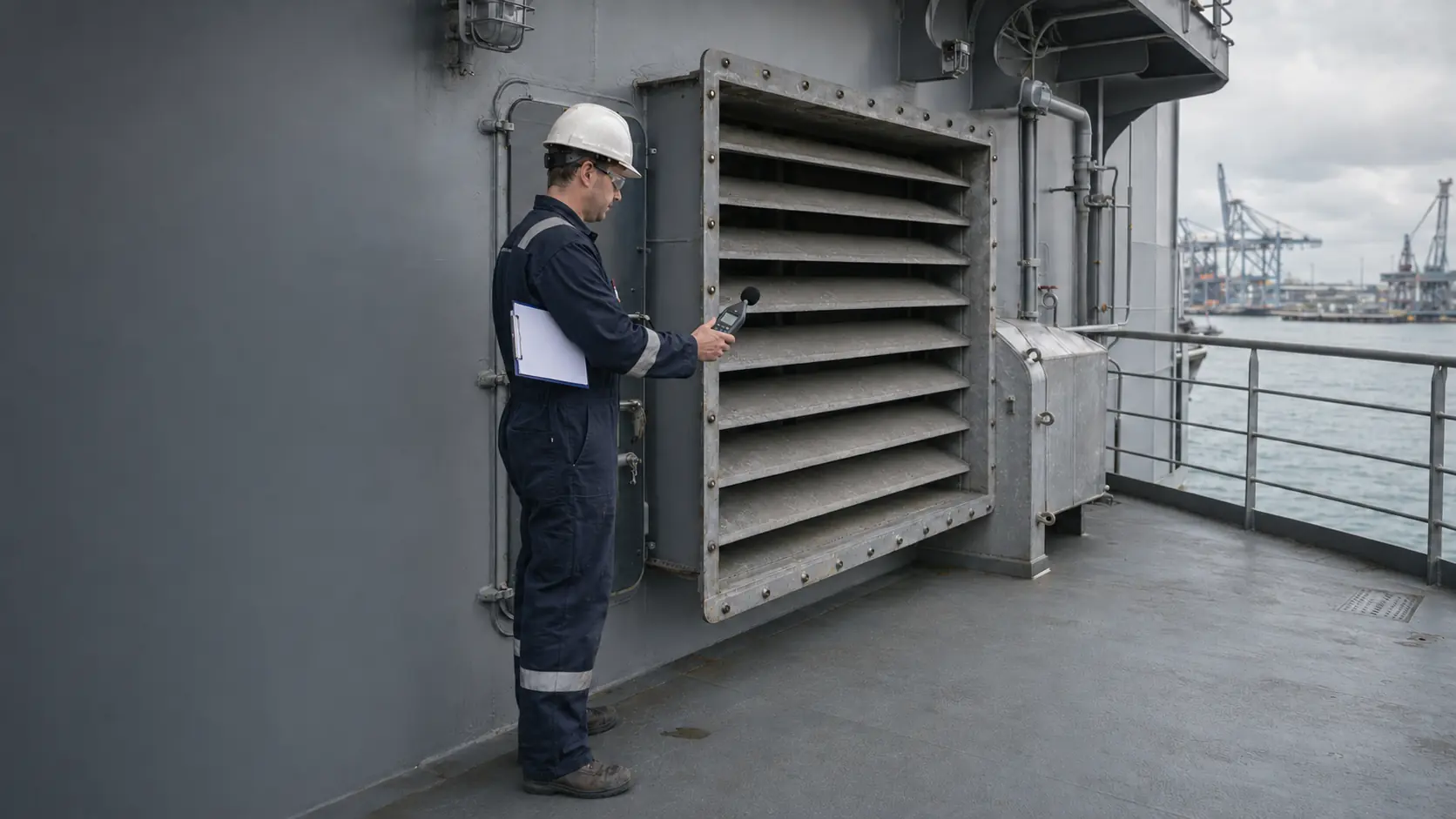
ACOUSTIC FIELD MAPPINGClear evidence→
VESSEL DOCTORNEPTUNES / ESI Airborne Noise Survey for Moored Ships
SURVEY PROFILENoise & Acoustics
08/21
01
WHY THIS SURVEY MATTERS
Evidence before assumption.
The NEPTUNES protocol creates a comparable method for evaluating ship noise emissions at berth. It goes beyond a single quay-side sound level by assessing dominant onboard sources, sound power, tonal characteristics, low-frequency content and operational context.
02
MEASUREMENT SCOPE
What we measure.
- ✓Dominant source sound pressure levels onboard
- ✓Exhaust/funnel, ventilation opening and equipment emissions
- ✓Quay-side or reference-position levels where required
- ✓Octave or one-third-octave spectra
- ✓Total sound power and low-frequency indicators
- ✓Tonal, intermittent or fluctuating characteristics
- ✓Meteorological and vessel operating conditions
03
TIMING & APPLICATION
When to request it.
Port incentive or environmental programme participation
Repeated community or port noise complaints
Baseline before noise-control modifications
Newbuilding environmental performance evaluation
Comparison of operating modes or equipment configurations
04
SURVEY PROCESS
A controlled route from plan to finding.
Define
Confirm the decision, vessel condition and evaluation basis.
Prepare
Agree locations, safe access, instruments and operating matrix.
Measure
Capture traceable data with conditions documented during measurement.
Interpret
Evaluate against the agreed basis and isolate meaningful patterns.
Report
Issue findings, limitations and focused next actions.
05
TECHNICAL DELIVERABLE
What you receive.
- ✓Measurement plan aligned with the required protocol
- ✓Source register and operating-condition documentation
- ✓Frequency-resolved source results
- ✓Calculated sound-power indicators
- ✓Tonal and low-frequency evaluation
- ✓Protocol-formatted report inputs and mitigation priorities
06
STANDARDS & PROJECT CRITERIA
The governing basis comes first.
Use the current applicable ESI/NEPTUNES Noise Measurement Protocol for moored ships and its referenced acoustic standards. Verify the current submission, accreditation and acceptance requirements with the receiving ESI/port body before mobilisation. Do not guarantee a port incentive or ESI score.
Important
Explore our standards directory↗Acceptance remains subject to the applicable flag administration, classification society, contract, vessel specification and authorised reviewing party.
ASIA + WORLDWIDE ATTENDANCE
NEPTUNES / ESI Airborne Noise Survey for Moored Ships wherever the vessel needs it.
Vessel Doctor coordinates this service for vessels in Singapore, India, Malaysia, Sri Lanka, Indonesia, Thailand, wider Asian maritime centres and ports worldwide. The scope can support technical managers, marine superintendents, ship agents, owners, operators, shipyards and consultants who need documented onboard evidence.
How clients describe this need: Projects may be described as NEPTUNES noise survey, ESI moored-ship noise test, berth noise measurement, ship sound-power assessment and port airborne-noise survey. Clients may also report that a ship at berth is causing a port or community noise concern, especially from exhausts, fans, pumps, generators or refrigerated cargo equipment. Depending on the technical question, the attendance may involve airborne-noise testing, source measurement, sound-power analysis, monitoring, survey, assessment or mitigation verification while moored at a port, terminal, berth, anchorage or shipyard under documented operating conditions. We confirm the final scope from the vessel, operating condition, access, applicable criteria, measurement purpose and required reporting outcome.
Southeast AsiaNEPTUNES / ESI Airborne Noise Survey for Moored Ships in Singapore↗South AsiaNEPTUNES / ESI Airborne Noise Survey for Moored Ships in India↗Southeast AsiaNEPTUNES / ESI Airborne Noise Survey for Moored Ships in Malaysia↗South AsiaNEPTUNES / ESI Airborne Noise Survey for Moored Ships in Sri Lanka↗Southeast AsiaNEPTUNES / ESI Airborne Noise Survey for Moored Ships in Indonesia↗Southeast AsiaNEPTUNES / ESI Airborne Noise Survey for Moored Ships in Thailand↗Global coverageWorldwide NEPTUNES / ESI Airborne Noise Survey for Moored Ships↗
SERVICE FAQ
Questions project teams ask.
Every scope is confirmed against the actual vessel, timing and decision requirement.
01Is NEPTUNES the same as the IMO onboard noise survey?+
No. IMO MSC.337(91) focuses on protecting people onboard; NEPTUNES/ESI focuses on airborne noise emitted by a moored ship into the port environment.
02Can the test be completed from the quay only?+
The required protocol may include onboard source measurements and specific reference positions. The final plan must follow the applicable protocol.
03Does a report guarantee an ESI incentive?+
No. Eligibility, scoring and incentives are controlled by ESI and participating ports and may change.
04Can you help reduce a poor score?+
We can identify dominant sources and prioritise operational or engineering controls, followed by verification measurements.
MOORED-SHIP AIRBORNE NOISE PLAN
Measure each berth noise source under a recorded operating condition.
A NEPTUNES measurement, ESI moored-ship noise test, port airborne-noise survey or ship sound-power assessment is useful only when source selection, machinery load, geometry, weather, background sound and limitations are documented together.
Find what is operating
List exhausts, ventilation openings, generators, pumps, refrigerated cargo equipment, cargo systems and other audible sources before selecting measurement positions.
Freeze the operating state
Record generator combinations, electrical and reefer load, HVAC and cargo activity, shore-power status, nearby vessels, port work, wind and precipitation.
Quantify dominant emitters
Measure the agreed source positions and frequency bands, then calculate or report source sound power and low-frequency contribution using the applicable protocol basis.
Prioritise noise control
Separate source ranking, port or community assessment, retrofit comparison and any formal programme submission because each requires a different acceptance pathway.
| Owner, port or yard need | Measurement evidence | Scope safeguard |
|---|---|---|
| Which shipboard source dominates noise at berth? | Onboard source inventory, close-source sound-pressure measurements, operating load and calculated source sound-power contribution. | A loud close reading alone does not prove the source dominates at a distant receiver. |
| Is low-frequency noise likely to drive the complaint? | Frequency-band results, agreed low-frequency calculation, operating condition and background comparison. | Weather, reflections, tones and unrelated port sources must be reported. |
| Did a silencer, enclosure, resilient mounting or operational change work? | Comparable before/after source state, geometry, load, method and uncertainty or repeatability statement. | Non-equivalent operating conditions can hide or exaggerate improvement. |
| Is a distant or shore-side verification feasible? | Surveyed geometry, suitable receiver positions, background, wind and port-access review before attendance. | Berth layout, safety and unrelated activity may make a valid distant measurement impossible. |
| Is a protocol or submission report required? | Current programme requirements, protocol version, instrument chain, calculation sheet, source photographs and traceable operating log. | Measurement competence and report acceptance must be confirmed for the intended programme and jurisdiction. |
Current NEPTUNES and ESI Noise status
Checked 8 August 2026: the official Environmental Ship Index information page states that new ESI Noise module applications are no longer accepted, while existing scores remain until expiry. The NEPTUNES/ESI measurement protocol can still provide a structured basis for moored-ship airborne-noise measurement, source ranking, port studies and noise-reduction decisions. Before commissioning work for a score, incentive or formal submission, confirm the current route directly with the programme administrator or receiving port.
Class, flag and attendance context
For ABS-, BV-, CCS-, CRS-, DNV-, IRS-, KR-, LR-, ClassNK-, PRS-, RINA- or Türk Loydu-classed vessels, and Singapore-, Panama-, Liberia-, Marshall Islands-, Bahamas-, Malta-, Cyprus-, Hong Kong- or Isle of Man-flagged ships, the owner should identify whether the report is for port assessment, contract acceptance, a notation, a flag review or ordinary troubleshooting. Attendance can be planned at a suitable berth in Singapore, Malaysia, India, Sri Lanka, Indonesia, Thailand, the Philippines, the Middle East, Asia-Pacific or worldwide, subject to access and measurement suitability. No class, flag or programme approval is implied.
START A TECHNICAL DISCUSSION
Plan your neptunes / esi airborne noise survey for moored ships.
Share the vessel, location, operating condition and reporting purpose. We will help shape a focused, technically defensible survey scope.