
Newbuilding acoustic acceptance
Noise & Acoustics · SERVICE 07
Onboard Sound Insulation and Sound Reduction Index Testing
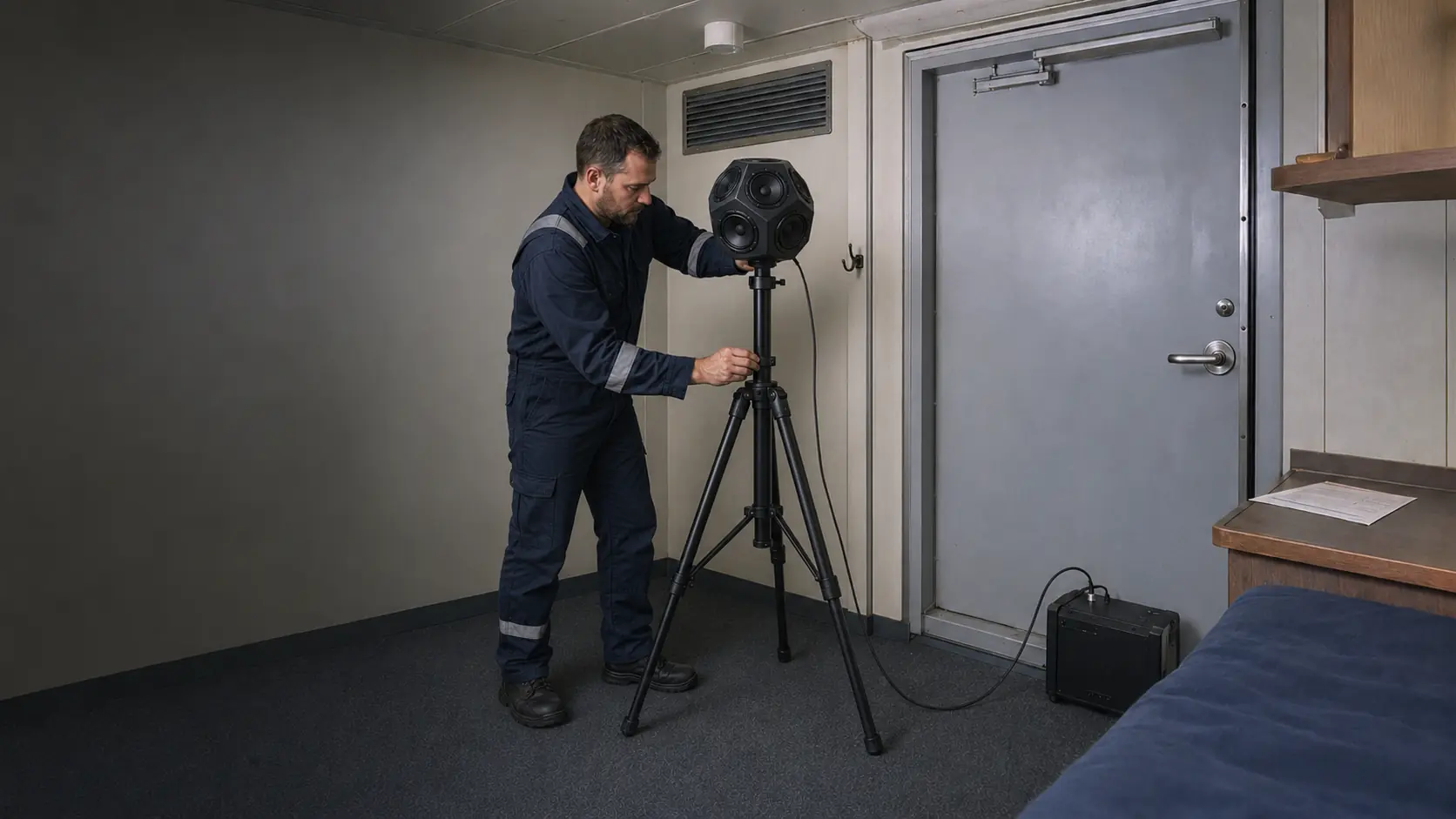
Low noise inside one space does not guarantee adequate acoustic privacy or protection between adjacent spaces. Doors, bulkheads, penetrations, ceilings, ventilation paths and workmanship can create transmission paths that weaken an otherwise well-designed partition. Vessel Doctor measures airborne sound insulation between selected vessel spaces and helps identify why performance falls below the agreed requirement.
ACOUSTIC FIELD MAPPINGClear evidence→
VESSEL DOCTOROnboard Sound Insulation and Sound Reduction Index Testing
SURVEY PROFILENoise & Acoustics
07/21
01
WHY THIS SURVEY MATTERS
Evidence before assumption.
Sound insulation affects rest, privacy, speech disturbance and the separation of noisy workspaces from accommodation. Testing is particularly valuable at newbuilding handover, after accommodation modification or when occupants report that voices, entertainment systems or operational noise are easily heard through partitions.
02
MEASUREMENT SCOPE
What we measure.
- ✓Source-room and receiving-room sound levels
- ✓Background noise in the receiving space
- ✓Frequency-dependent level difference
- ✓Reverberation time or equivalent absorption where the method requires it
- ✓Weighted sound reduction or apparent sound insulation rating
- ✓Leakage indicators around doors, seals, penetrations and ventilation paths
03
TIMING & APPLICATION
When to request it.
Cabin-to-cabin privacy complaints
Noisy-space to accommodation verification
After bulkhead, door or ceiling modification
Investigation of flanking transmission
Corrective-work verification
04
SURVEY PROCESS
A controlled route from plan to finding.
Define
Confirm the decision, vessel condition and evaluation basis.
Prepare
Agree locations, safe access, instruments and operating matrix.
Measure
Capture traceable data with conditions documented during measurement.
Interpret
Evaluate against the agreed basis and isolate meaningful patterns.
Report
Issue findings, limitations and focused next actions.
05
TECHNICAL DELIVERABLE
What you receive.
- ✓Tested partition and space schedule
- ✓Source, receiving and background measurement results
- ✓Frequency-band analysis and calculated rating
- ✓Evaluation against the agreed requirement
- ✓Observed leakage paths and workmanship concerns
- ✓Targeted acoustic-improvement recommendations
06
STANDARDS & PROJECT CRITERIA
The governing basis comes first.
Apply the IMO Noise Code, applicable class/contract criteria and the method required by the project. Where accepted, use relevant editions of ISO 16283-1 for field measurement and ISO 717-1 for rating; older contracts may specify legacy ISO 140 methods. Confirm the governing method before testing.
Important
Explore our standards directory↗Acceptance remains subject to the applicable flag administration, classification society, contract, vessel specification and authorised reviewing party.
ASIA + WORLDWIDE ATTENDANCE
Onboard Sound Insulation and Sound Reduction Index Testing wherever the vessel needs it.
Vessel Doctor coordinates this service for vessels in Singapore, India, Malaysia, Sri Lanka, Indonesia, Thailand, wider Asian maritime centres and ports worldwide. The scope can support technical managers, marine superintendents, ship agents, owners, operators, shipyards and consultants who need documented onboard evidence.
How clients describe this need: Projects may be described as ship sound-insulation testing, onboard sound reduction index measurement, cabin acoustic survey and vessel noise-transmission assessment. Clients may also report that speech, music or machinery noise passes too easily between cabins, through doors, bulkheads, ceilings or ventilation paths. Depending on the technical question, the attendance may involve sound-insulation testing, acoustic measurement, leakage inspection, reduction-index survey, assessment or troubleshooting at newbuilding handover, after accommodation work, during shipyard acceptance or while investigating privacy and noise complaints. We confirm the final scope from the vessel, operating condition, access, applicable criteria, measurement purpose and required reporting outcome.
Southeast AsiaOnboard Sound Insulation and Sound Reduction Index Testing in Singapore↗South AsiaOnboard Sound Insulation and Sound Reduction Index Testing in India↗Southeast AsiaOnboard Sound Insulation and Sound Reduction Index Testing in Malaysia↗South AsiaOnboard Sound Insulation and Sound Reduction Index Testing in Sri Lanka↗Southeast AsiaOnboard Sound Insulation and Sound Reduction Index Testing in Indonesia↗Southeast AsiaOnboard Sound Insulation and Sound Reduction Index Testing in Thailand↗Global coverageWorldwide Onboard Sound Insulation and Sound Reduction Index Testing↗
SERVICE FAQ
Questions project teams ask.
Every scope is confirmed against the actual vessel, timing and decision requirement.
01Is sound reduction index the same as room noise level?+
No. Room noise measures the sound present in a space; sound insulation measures how effectively a separating construction reduces transmission between spaces.
02Can you test cabin doors separately?+
The field result normally represents the complete separating construction, including the door and flanking paths. Component testing requires a different method.
03What commonly causes poor performance?+
Door seals, unsealed penetrations, back-to-back sockets, ceiling voids, ventilation transfer paths and rigid structural connections are frequent contributors.
04Can the survey recommend repairs?+
Yes. Recommendations can prioritise likely leakage and transmission paths, followed by verification testing after corrections.
METHOD SELECTION & REPORT EVIDENCE
Choose the sound-insulation test that answers the vessel problem.
Onboard field sound-insulation testing, laboratory sound reduction index data and a simple cabin noise reading are not interchangeable. The test must match the partition, door, space pair, specified rating and commercial decision.
Start with five project essentials
- Vessel, attendance location and timing.
- Source and receiving spaces or the partition to investigate.
- Bulkhead, deck, door, lining, penetration and ventilation details.
- Purpose: newbuilding acceptance, privacy complaint, retrofit or repair verification.
- Contract criterion, requested metric and report-review route.
Expected technical evidence
- Test-pair schedule and separating-construction description.
- Source, receiving and background sound-pressure results.
- Reverberation or absorption correction when the selected method requires it.
- Frequency-band results, calculated rating and stated method.
- Observed leakage or flanking paths, limitations and corrective priorities.
| Buyer wording | Appropriate route | Important limitation |
|---|---|---|
| Onboard, on-board or shipboard sound-insulation test between cabins | Field airborne sound-insulation measurement across the complete source/receiving space pair. | The result may include doors, penetrations and flanking paths; it is not automatically a laboratory product rating. |
| Sound reduction index, Rw, R′w or DnT,w evidence | Confirm the required field or laboratory method and rating quantity before testing. | A room sound-level spot check cannot produce a defensible insulation rating. |
| Noise or speech passes through a door or bulkhead | Controlled transmission test plus leakage and flanking-path inspection. | Replacing one component may not fix a bypass path through ceilings or ventilation. |
| Cabin remains noisy only when machinery runs | Onboard noise measurement with transmission-path diagnostics. | Airborne and structure-borne contributions must not be assumed from audibility alone. |
Method, class and flag review context
Where the applicable contract or review basis calls for field airborne sound insulation, ISO 16283-1 provides room-to-room measurement procedures and ISO 717-1 defines relevant single-number ratings. Their use onboard must be agreed for the actual space, project criterion and reviewing party. Reports can be prepared for classed-vessel or flag review without claiming approval, recognition or guaranteed acceptance. Attendance may be coordinated across Singapore, Malaysia, India, Sri Lanka, Indonesia, Thailand, the Philippines, the Middle East, Asia-Pacific and worldwide. Review reverberation and speech-intelligibility testing.
Technical guide: Read the Rw, R′w and DnT,w technical guide.
START A TECHNICAL DISCUSSION
Plan your onboard sound insulation and sound reduction index testing.
Share the vessel, location, operating condition and reporting purpose. We will help shape a focused, technically defensible survey scope.
TEST-PAIR PLANNING
Define each cabin, door and partition test pair.
Sound reduction index and field sound-insulation results answer a transmission question between a source space and a receiving space. A room-noise reading alone cannot show how much sound a bulkhead, door, deck or complete separating construction reduces.
01 · SPACE PAIRS
Identify source and receiving rooms, separating element, door condition, ventilation openings, ceiling voids and penetrations. Mark the pairs on a general arrangement drawing.
02 · TEST CONDITIONS
Reserve safe access to both spaces, control unrelated activity, document background noise and decide whether reverberation time or equivalent absorption is required by the selected method.
03 · DECISION BASIS
State whether the work supports newbuilding acceptance, retrofit verification, cabin-privacy investigation, workmanship review or troubleshooting against a contract or project criterion.
| What the crew or owner reports | Likely route to examine | Useful measurement decision |
|---|---|---|
| Speech or television is clear in the next cabin. | Door seals, bulkhead penetrations, ceiling void or ventilation transfer path. | Field airborne sound-insulation test across the complete separating construction. |
| A cabin is noisy only when machinery operates. | Airborne ingress, structure-borne transmission or both. | Combine onboard noise measurement with transmission-path diagnostics. |
| A replacement door did not improve privacy. | Perimeter leakage, threshold, frame or a flanking path bypassing the door. | Compare controlled test pairs and inspect leakage before prescribing further work. |
| The specification requests an SRI, R′w or DnT,w result. | The exact metric and field/laboratory method may differ. | Confirm the governing contract, ISO method and rating quantity before testing. |
Classed-vessel, flag and contract context
For vessels classed by ABS, DNV, Lloyd’s Register, Bureau Veritas, RINA, ClassNK or another society, and for Singapore-, Panama-, Liberia-, Marshall Islands-, Bahamas-, Malta-, Cyprus-, Hong Kong- or Isle of Man-flagged vessels, acceptance depends on the applicable rule, notation, statutory requirement, vessel specification and reviewing party. The owner or yard should confirm the required metric and any supplier qualification before the test. Review the standards directory.