Define
Confirm the vessel, installed system, spaces, operating condition, criteria and reporting purpose.
Environmental & Acceptance Testing · SERVICE 21
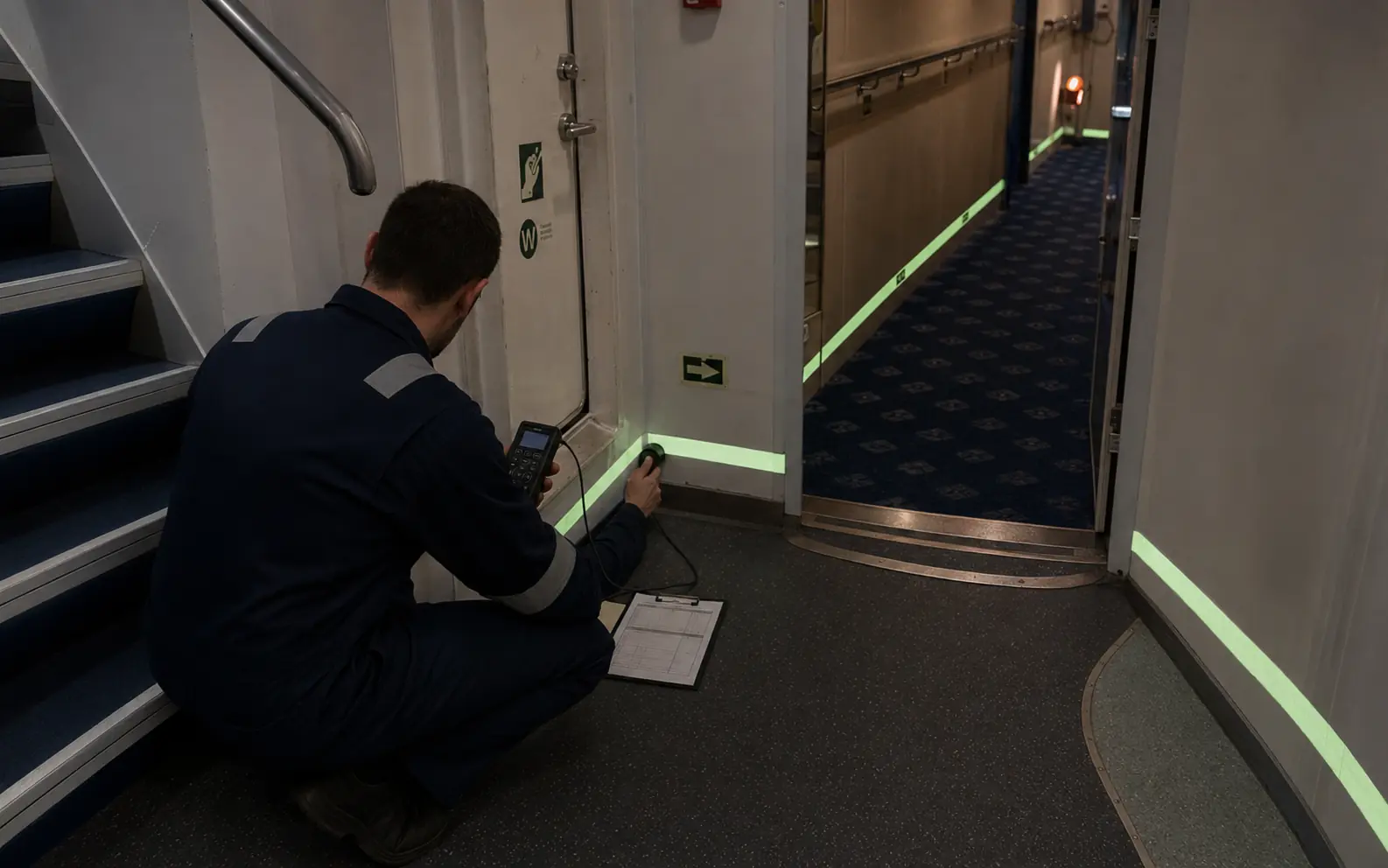
Low-location lighting helps people identify escape routes when smoke reduces the effectiveness of normal emergency lighting. Vessel Doctor inspects the installed route and measures the agreed performance characteristics of photoluminescent or electrically powered systems for applicable passenger ships and project requirements.
 ESCAPE ROUTE LLL
01
WHY THIS SURVEY MATTERS
A low-location system must remain continuous, visible and maintained along the required escape route. Missing, damaged, obstructed or underperforming sections can reduce guidance at the moment it is most needed. The survey documents the route, system condition, measured evidence and limitations for technical review.
02
MEASUREMENT SCOPE
03
WHEN TO REQUEST IT
04
SURVEY PROCESS
Confirm the vessel, installed system, spaces, operating condition, criteria and reporting purpose.
Agree locations, power or charging condition, access, instrumentation and safety requirements.
Capture repeatable readings and observations under documented conditions.
Compare the evidence with the agreed vessel-specific requirement and recorded limitations.
Deliver clear findings, priorities and practical recommendations for the next action.
05
REPORTING OUTPUT
06
APPLICABLE BASIS
Applicability is vessel-specific. Relevant references can include SOLAS chapter II-2 regulation 13.3.2.5.1, chapter 11 of the FSS Code, IMO Resolution A.752(18), ISO 15370:2021 and Amendment 1:2023. Escape-route signs and equipment markings may also require review against the applicable IMO and ISO signage provisions. Final interpretation, approval and statutory acceptance remain with the flag Administration, recognised organisation or other authorised party.
Clients may describe this requirement as a ship LLL test, low-location light survey, low-level lighting inspection, photoluminescent strip test, escape-route lighting survey, passenger-ship LLL luminance measurement or smoke escape guidance inspection.
ASIA + WORLDWIDE ATTENDANCE
Attendance can be coordinated for Singapore, India, Malaysia, Sri Lanka, Indonesia, Thailand, wider Asian maritime centres and ports worldwide, subject to scope, feasibility and applicable requirements.
SERVICE FAQ
Every scope is confirmed against the actual vessel, installation and decision requirement.
No. The SOLAS and project applicability depends on vessel type, passenger capacity, construction or modification history, flag and other governing requirements. Applicability must be confirmed before the scope is agreed.
No. Low-location lighting supplements required emergency lighting by marking escape routes close to deck level, where smoke may obscure higher-level signs and lights.
Yes, but the preparation, operating condition and measurement procedure differ. The installed system type must be confirmed before attendance.
No. The survey provides documented evidence. Final approval, certification or acceptance remains with the applicable authorised party.
ESCAPE-ROUTE LLL TEST PLAN
A ship low-location-lighting survey, inspection or luminance test should verify more than one bright strip. The assessment identifies the installed photoluminescent or electrically powered system, traces route continuity, records doors, stairs, junctions and signs, applies the required charging, isolation or power-loss condition and measures the specified performance at controlled times.
Identify the passenger-ship or project requirement, escape routes in scope, system type, drawings, approval information, previous findings and the governing edition.
Record ambient illumination, charging exposure, lamp and battery state, darkness or isolation period, temperature, obstructions, recent replacement and any temporary light.
Follow corridors, doors, stairs, landings, crossings, changes of direction and assembly-route interfaces for continuity, visibility, damage, contamination and correct marking.
Measure luminance or electrical performance at the points and elapsed times required by the agreed basis, retaining meter, calibration, location, condition and exception records.
| Installed condition or buyer question | Evidence to capture | Decision boundary |
|---|---|---|
| Photoluminescent strips appear dim after lights are lost | Product and route identification, prescribed preconditioning, charging illuminance and duration, controlled darkness, timed luminance readings, temperature, contamination and damaged or replaced sections. | A reading taken without the specified charging and dark-adaptation sequence is not comparable with the governing criterion. |
| Electrically powered LLL has intermittent or failed sections | Normal and emergency supply state, changeover, continuity, failed segments, battery or central-source condition, controls, monitoring indications and duration evidence where included. | A visual lamp check does not prove the required emergency operating period. |
| Escape route is confusing at doors, stairs or junctions | Continuous route walk-through, direction and exit markings, height and visibility, door and stair transitions, obstructions, contrasting background and photographs tied to location IDs. | Acceptable local brightness cannot compensate for a broken or misleading escape-route sequence. |
| Support renewal, annual survey, repair, class or flag review | Named rule and edition, approved arrangement information, complete scope, supplier-qualification requirement, witness route, calibrated instrument evidence, defects, repair list and retest record. | Project-specific report acceptance is different from approval of the system product or recognition of the service supplier. |
IMO Resolution A.752(18) is the guideline for evaluating, testing and applying low-location lighting on passenger ships. ISO 15370:2021, together with its 2023 amendment where applicable, covers approval, installation and maintenance in the SOLAS II-2/13.3.2.5.1 and FSS Code chapter 11 context. The agreed vessel-specific rule, edition and system instructions control the actual test points, conditioning and limits.
Send the vessel and IMO number, passenger capacity and vessel type, class and flag, LLL arrangement drawing, system manufacturer and type, photoluminescent or electrical construction, approval documents, affected decks and routes, previous report or deficiencies, replacements, charging and emergency-power information, required witness, port, ETA/ETD and report deadline. Attendance can be assessed at berth, anchorage, port, shipyard or dry dock in Singapore, Malaysia, India, Sri Lanka, Indonesia, Thailand, the Philippines, the Middle East, Asia-Pacific and worldwide.
ABS-, BV-, CCS-, CRS-, DNV-, IRS-, KR-, LR-, ClassNK-, PRS-, RINA- and Türk Loydu-classed vessels, and Singapore-, Panama-, Liberia-, Marshall Islands-, Bahamas-, Malta-, Cyprus-, Hong Kong- and Isle of Man-flagged ships, may have different supplier-qualification, witnessing and acceptance requirements. The owner or yard should confirm the route with the attending society and flag administration before booking. Vessel Doctor does not claim class, flag or service-supplier approval here.
PLAN THE RIGHT MEASUREMENT
Share the vessel type, location, system information, schedule, governing requirement and required deliverable. We will review the appropriate measurement scope and attendance requirements.