
When crew regularly enter high-noise areas
Noise & Acoustics · SERVICE 09
Onboard Personal Noise Exposure Monitoring
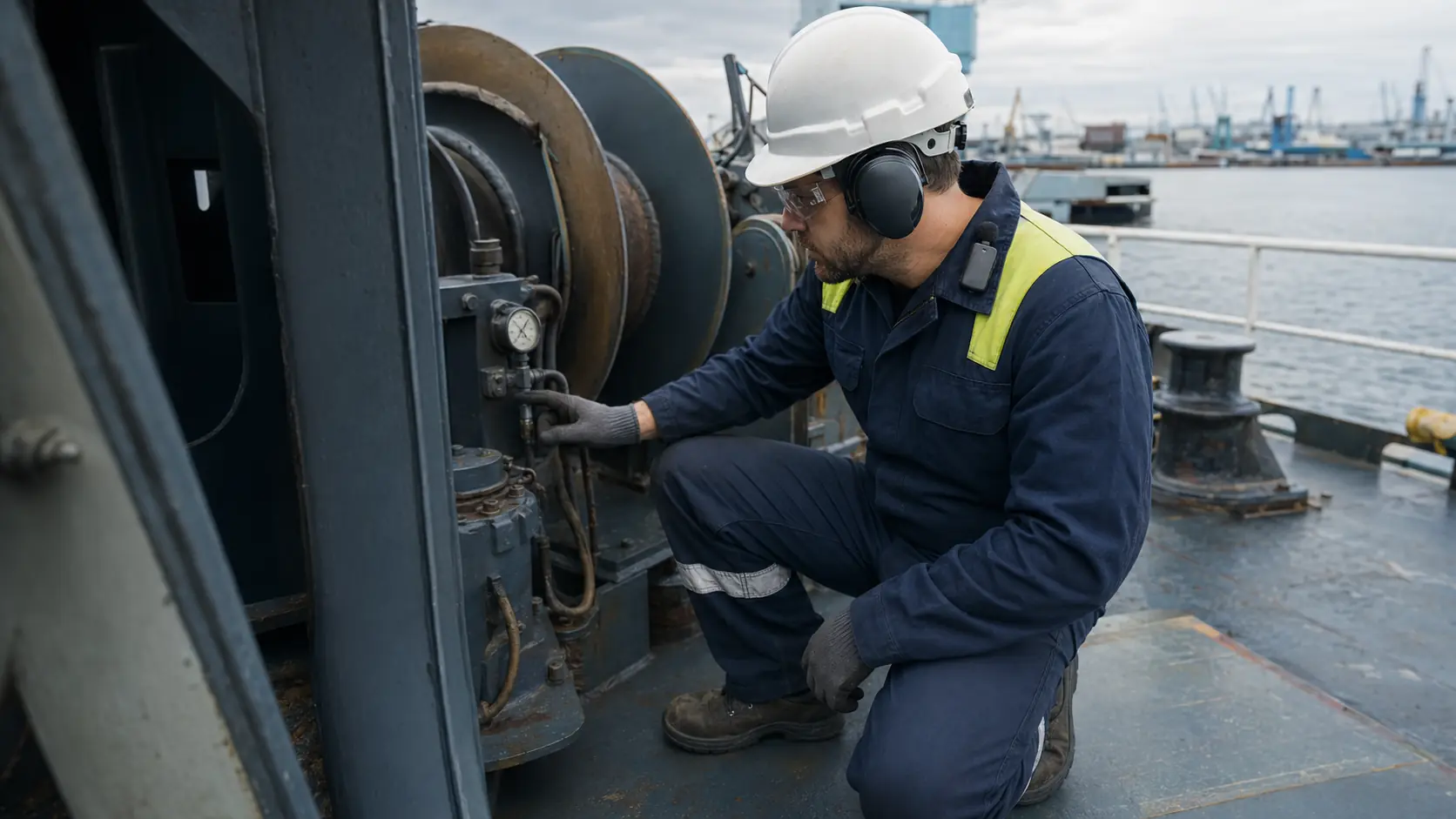
Area measurements show how noisy a space is; personal dosimetry shows the exposure a person accumulates while moving through a real working day. Vessel Doctor monitors representative crew roles and tasks to identify the activities, locations and durations that contribute most to daily occupational noise exposure.
ACOUSTIC FIELD MAPPINGClear evidence→
VESSEL DOCTOROnboard Personal Noise Exposure Monitoring
SURVEY PROFILENoise & Acoustics
09/21
01
WHY THIS SURVEY MATTERS
Evidence before assumption.
Engineers, deck crew, maintenance teams and other personnel may experience short high-level tasks combined with lower exposures across a shift. Personal monitoring supports evidence-based hearing conservation, task planning, protection selection and evaluation of engineering or administrative controls.
02
MEASUREMENT SCOPE
What we measure.
- ✓Personal daily noise exposure and dose
- ✓Equivalent continuous exposure level
- ✓Maximum and peak levels where required
- ✓Task, location and time history
- ✓Representative work groups or job functions
- ✓Hearing-protection use and relevant work observations
03
TIMING & APPLICATION
When to request it.
Following changes to machinery or work practices
To validate a hearing-conservation programme
After occupational-noise complaints or concerns
When area measurements cannot represent mobile work
To evaluate controls before and after implementation
04
SURVEY PROCESS
A controlled route from plan to finding.
Define
Confirm the decision, vessel condition and evaluation basis.
Prepare
Agree locations, safe access, instruments and operating matrix.
Measure
Capture traceable data with conditions documented during measurement.
Interpret
Evaluate against the agreed basis and isolate meaningful patterns.
Report
Issue findings, limitations and focused next actions.
05
TECHNICAL DELIVERABLE
What you receive.
- ✓Monitoring strategy and selected exposure groups
- ✓Dosimeter configuration and calibration checks
- ✓Individual and group exposure results
- ✓Task-based contribution analysis where recorded
- ✓Evaluation against the agreed occupational criteria
- ✓Control priorities following the hierarchy of controls
06
STANDARDS & PROJECT CRITERIA
The governing basis comes first.
Use the IMO Code on Noise Levels on Board Ships where applicable, the relevant flag/occupational requirements, ISO 9612 principles where appropriate and personal sound exposure meters compliant with IEC 61252. Confirm criterion level, exchange rate and threshold before interpreting dose.
Important
Explore our standards directory↗Acceptance remains subject to the applicable flag administration, classification society, contract, vessel specification and authorised reviewing party.
ASIA + WORLDWIDE ATTENDANCE
Onboard Personal Noise Exposure Monitoring wherever the vessel needs it.
Vessel Doctor coordinates this service for vessels in Singapore, India, Malaysia, Sri Lanka, Indonesia, Thailand, wider Asian maritime centres and ports worldwide. The scope can support technical managers, marine superintendents, ship agents, owners, operators, shipyards and consultants who need documented onboard evidence.
How clients describe this need: Projects may be described as onboard personal noise monitoring, ship crew dosimetry, seafarer noise-exposure assessment and occupational noise-dose testing. Clients may also report that crew members work in noisy areas and the owner needs to understand hearing risk across a real shift or task. Depending on the technical question, the attendance may involve personal monitoring, dosimetry, exposure measurement, task assessment, hearing-risk evaluation or control verification during normal duties, maintenance, cargo operations, engine-room work, sea passage or representative port operations. We confirm the final scope from the vessel, operating condition, access, applicable criteria, measurement purpose and required reporting outcome.
Southeast AsiaOnboard Personal Noise Exposure Monitoring in Singapore↗South AsiaOnboard Personal Noise Exposure Monitoring in India↗Southeast AsiaOnboard Personal Noise Exposure Monitoring in Malaysia↗South AsiaOnboard Personal Noise Exposure Monitoring in Sri Lanka↗Southeast AsiaOnboard Personal Noise Exposure Monitoring in Indonesia↗Southeast AsiaOnboard Personal Noise Exposure Monitoring in Thailand↗Global coverageWorldwide Onboard Personal Noise Exposure Monitoring↗
SERVICE FAQ
Questions project teams ask.
Every scope is confirmed against the actual vessel, timing and decision requirement.
01How is personal monitoring different from noise mapping?+
A noise map describes spaces; a dosimeter follows a worker and integrates exposure over time.
02How many crew members must be monitored?+
The number depends on work groups, task variability and the confidence required. Representative selection is more important than an arbitrary percentage.
03Can a dosimeter be worn during normal duties?+
Yes, provided it is mounted correctly and does not interfere with safety or work.
04Does wearing hearing protection reduce the measured dose?+
A shoulder-mounted dosimeter normally measures external exposure. Protection effectiveness is assessed separately using suitable methods and assumptions.
CREW EXPOSURE-DOSIMETRY PLAN
Build exposure from representative people, tasks and time.
A noise map describes a space; personal dosimetry follows a crew member through the real work pattern. The monitoring strategy must define representative roles, criterion settings, task and location logs, abnormal events and the measured portion of the workday before an exposure level or dose can support a hearing-conservation decision.
Select representative work
Define similar-exposure roles from duties, watch pattern, locations, machinery, maintenance and expected variability instead of choosing an arbitrary percentage of crew.
Agree the criterion first
Set the dosimeter, exchange rate, threshold, criterion level, peak channel, integration period and reporting basis required by the applicable method.
Keep a task and event log
Record work, location, start/finish time, machinery state, hearing protection, breaks, unusual impacts, microphone disturbance and any period not worn.
Separate dose from source
Normalise only on an agreed basis, identify influential tasks and uncertainty, and combine area or task measurements when the control decision needs source evidence.
| Exposure question | Monitoring evidence | Important limitation |
|---|---|---|
| Engineer or deck crew move through several noise zones | Representative-shift dosimetry, time-synchronised task/location log, machinery and cargo state, breaks, hearing-protection observations and focused area checks for influential tasks. | A high integrated result cannot be assigned to a source without a reliable task and event history. |
| Short maintenance, mooring or machinery tasks are very loud | Task duration and repeat frequency, logging dosimetry or task-based sound level, maximum/peak channel where required, tool or machinery condition and protective measures. | A short high-level event and daily exposure answer different questions; both criteria may need review. |
| Watchkeeping, overtime or voyage duties vary between days | Multiple representative periods or a justified task-based strategy covering normal and credible high-exposure work, with actual durations and deviations recorded. | One convenient or unusually quiet day may not represent the exposure group. |
| Verify a silencer, enclosure, procedure or schedule change | Matched before/after role, task, duration, load and location evidence, plus source or area measurements when needed to explain the change. | Different production, weather, machinery or task duration can hide or exaggerate the control effect. |
| Support occupational, owner, class or flag review | Named criterion and standard edition, sampling strategy, representative personnel rationale, instrument and field-calibration evidence, settings, logs, excluded periods, uncertainty and results. | Dose percentage is not portable across different criterion levels, exchange rates or thresholds. |
Current exposure-method and shipboard references
ISO 9612:2025 specifies a methodology for measuring occupational noise exposure and calculating the exposure level using defined strategies. The IMO resolution index identifies MSC.337(91) as adoption of the Code on Noise Levels on Board Ships. The applicable flag, occupational regime, ship type, contract and project purpose determine the final criterion; personal sound exposure meters and field checks must match the agreed method.
Information needed before mobilisation
Provide the vessel and IMO number, crew roles and headcount, watch pattern, normal and unusual tasks, engine-room/cargo/deck operating plan, expected high-noise work, prior area survey, hearing-protection programme, relevant flag or occupational criteria, access and safety limits, language needs and representative monitoring window. Service availability can be assessed in Singapore, Malaysia, India, Sri Lanka, Indonesia, Thailand, the Philippines, the Middle East, Asia-Pacific and worldwide without implying a local office or guaranteed mobilisation.
Acceptance and worker context
Exposure monitoring supports an owner, operator, occupational-hygiene programme, flag administration or attending class surveyor only within the agreed scope. Individual data handling, crew briefing, device placement, interference checks and report access should follow the vessel's safety and privacy arrangements. No class, flag or statutory approval is claimed.
START A TECHNICAL DISCUSSION
Plan your onboard personal noise exposure monitoring.
Share the vessel, location, operating condition and reporting purpose. We will help shape a focused, technically defensible survey scope.