
Unusual noise, vibration or temperature
Vibration & Dynamics · SERVICE 03
Marine Machinery Vibration Analysis
Rotating machinery usually provides measurable warning before a developing defect becomes an operational failure. Vessel Doctor collects and analyses vibration from engines, generators, pumps, fans, compressors, gearboxes and supporting systems to identify abnormal mechanical behaviour and establish a dependable baseline for maintenance decisions.
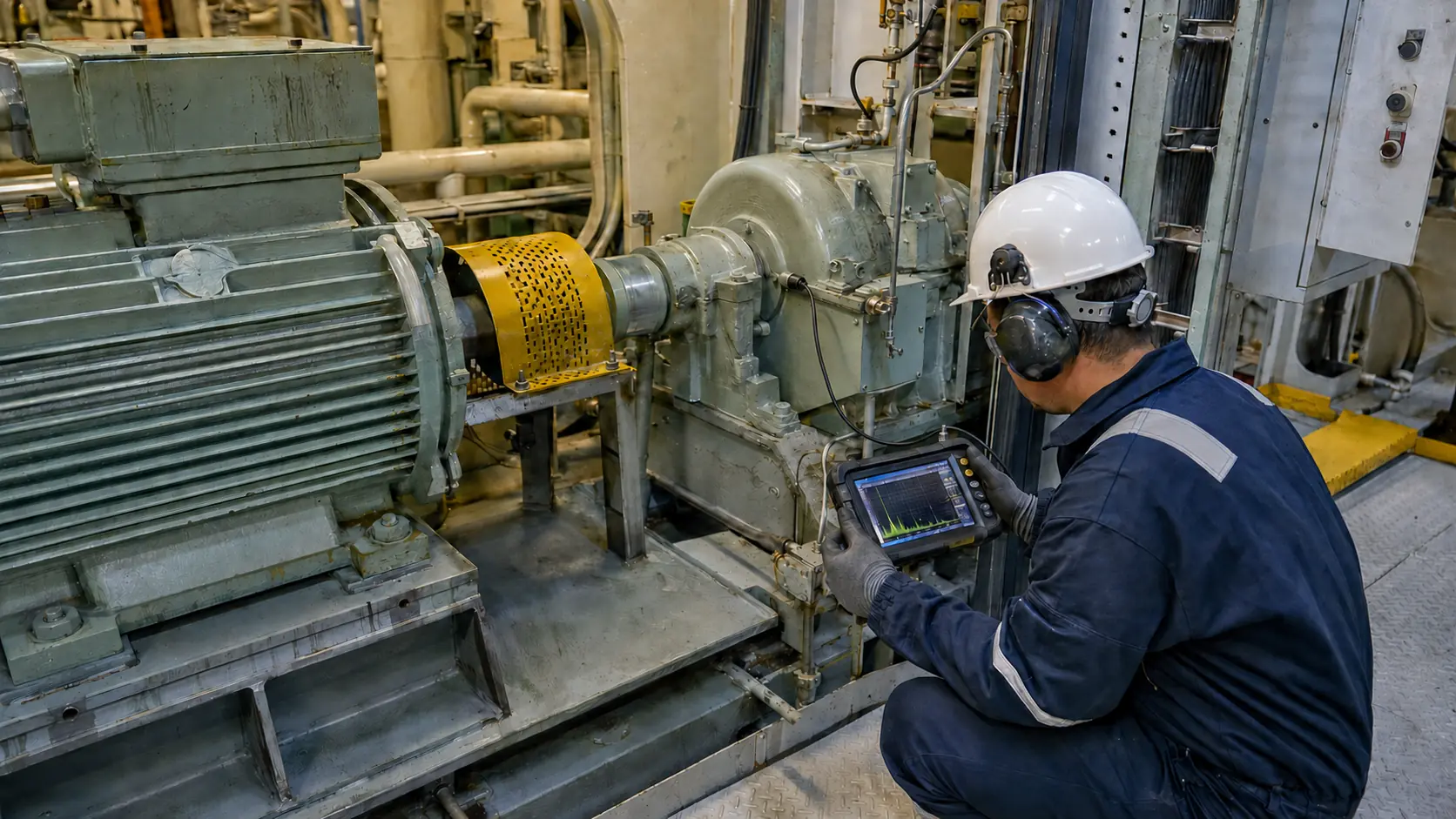
VIBRATION SPECTRUMClear evidence→
VESSEL DOCTORMarine Machinery Vibration Analysis
SURVEY PROFILEVibration & Dynamics
03/21
01
WHY THIS SURVEY MATTERS
Evidence before assumption.
Excessive vibration may be associated with imbalance, misalignment, mechanical looseness, bearing deterioration, resonance, gear defects, cavitation or changes in foundation stiffness. Trendable, correctly located measurements are more valuable than isolated readings because they reveal direction, frequency and change over time.
02
MEASUREMENT SCOPE
What we measure.
- ✓Overall velocity, acceleration and displacement where appropriate
- ✓Time waveform and frequency spectrum
- ✓Bearing-housing vibration in relevant directions
- ✓Rotational speed and order-related components
- ✓Generator, pump, fan, compressor and gearbox condition
- ✓Foundation, mount and connected-pipe response
- ✓Comparative data across load states or sister machines
03
TIMING & APPLICATION
When to request it.
Repeated bearing or coupling failures
After overhaul, alignment or equipment replacement
Before a planned maintenance shutdown
During acceptance testing or sea trials
To establish a predictive-maintenance baseline
04
SURVEY PROCESS
A controlled route from plan to finding.
Define
Confirm the decision, vessel condition and evaluation basis.
Prepare
Agree locations, safe access, instruments and operating matrix.
Measure
Capture traceable data with conditions documented during measurement.
Interpret
Evaluate against the agreed basis and isolate meaningful patterns.
Report
Issue findings, limitations and focused next actions.
05
TECHNICAL DELIVERABLE
What you receive.
- ✓Machine and measurement-point register
- ✓Operating-condition record
- ✓Spectra, waveforms and overall values
- ✓Severity evaluation against the agreed basis
- ✓Probable fault indicators and confidence notes
- ✓Maintenance priorities and recommended follow-up tests
06
STANDARDS & PROJECT CRITERIA
The governing basis comes first.
Use ISO 20283-4 for ship propulsion machinery where applicable, relevant parts of ISO 20816, manufacturer limits, class rules and established baseline/trend criteria. Never apply a generic limit to equipment for which it is not technically valid.
Important
Explore our standards directory↗Read the marine machinery vibration diagnostic guide↗Acceptance remains subject to the applicable flag administration, classification society, contract, vessel specification and authorised reviewing party.
ASIA + WORLDWIDE ATTENDANCE
Marine Machinery Vibration Analysis wherever the vessel needs it.
Vessel Doctor coordinates this service for vessels in Singapore, India, Malaysia, Sri Lanka, Indonesia, Thailand, wider Asian maritime centres and ports worldwide. The scope can support technical managers, marine superintendents, ship agents, owners, operators, shipyards and consultants who need documented onboard evidence.
How clients describe this need: Projects may be described as ship machinery vibration analysis, marine machinery monitoring, engine vibration test, rotating-equipment assessment and vessel machinery diagnostics. Clients may also report that an engine, generator, pump, fan, compressor or gearbox is shaking, making abnormal noise, overheating or repeatedly failing. Depending on the technical question, the attendance may involve vibration testing, measurement, condition monitoring, spectrum analysis, diagnostic assessment, health check or troubleshooting at berth, in a yard or dry dock, during harbour or sea trials, after overhaul, before delivery or during normal operation. We confirm the final scope from the vessel, operating condition, access, applicable criteria, measurement purpose and required reporting outcome.
Southeast AsiaMarine Machinery Vibration Analysis in Singapore↗South AsiaMarine Machinery Vibration Analysis in India↗Southeast AsiaMarine Machinery Vibration Analysis in Malaysia↗South AsiaMarine Machinery Vibration Analysis in Sri Lanka↗Southeast AsiaMarine Machinery Vibration Analysis in Indonesia↗Southeast AsiaMarine Machinery Vibration Analysis in Thailand↗Global coverageWorldwide Marine Machinery Vibration Analysis↗
SERVICE FAQ
Questions project teams ask.
Every scope is confirmed against the actual vessel, timing and decision requirement.
01Can vibration analysis confirm a failing bearing?+
It can identify patterns consistent with bearing defects, but confirmation may require lubrication analysis, temperature data, inspection or repeat trending.
02Do you need historical data?+
Historical data improves confidence, but a useful baseline and diagnostic assessment can still be developed from a first survey.
03Can measurements be completed while the vessel operates?+
Yes, provided the machinery can be safely accessed and the operating state is documented.
04Will the report state whether machinery is safe to run?+
We report measured condition and diagnostic indicators. Operational decisions remain with the vessel’s authorised technical management, manufacturer and relevant class/flag requirements.
START A TECHNICAL DISCUSSION
Plan your marine machinery vibration analysis.
Share the vessel, location, operating condition and reporting purpose. We will help shape a focused, technically defensible survey scope.
VIBRATION DIAGNOSTIC PLAN
Measure the machine, operating condition and transmission path together.
Marine machinery vibration testing becomes diagnostic only when each value is tied to its point, direction, RPM, load and machine state. The objective is not merely to record a high number; it is to distinguish forcing, response and change.
Define what changed
Record when vibration started, the affected machine or space, RPM band, load, recent overhaul, recurring failure, temperature and unusual noise.
Capture the path
Measure relevant bearing housings, casing, mounts, foundation, connected pipework and nearby deck in consistent horizontal, vertical and axial directions.
Control comparisons
Document running equipment, RPM, load, valves, electrical demand, vessel speed and each change during harbour trial, sea trial or in-service testing.
Use more than one clue
Relate overall values, spectrum, waveform, phase, temperature, lubrication, alignment and inspection evidence before naming a probable fault.
| Observed behaviour | Useful comparison | Diagnostic caution |
|---|---|---|
| High vibration at one RPM band | Run-up/coast-down amplitude and phase; machine, foundation and deck response. | A narrow speed-sensitive peak may indicate resonance, but one steady reading cannot prove it. |
| Strong running-speed response | Radial directions, phase, load and sister-point comparison. | Imbalance is one possibility; misalignment, eccentricity or structural response can look similar. |
| Repeated bearing or coupling failure | Both sides of the coupling, alignment state, soft foot, pipe strain, temperature and high-frequency bearing data. | Do not replace parts repeatedly without checking the transmitted force and installation condition. |
| Vibration travels into cabins or the bridge | Source-to-path-to-receiver measurements under the same operating state. | Use habitability vibration or structural vibration testing when the decision is not machinery condition alone. |
| Need an early-warning trend rather than one diagnosis | Repeatable route, alarm philosophy and consistent load/speed state. | Use vessel machinery condition monitoring for ongoing machine-health surveillance. |
Classification, flag and acceptance context
For ABS-, DNV-, Lloyd’s Register-, Bureau Veritas-, RINA- or ClassNK-classed vessels and major flag administrations, the applicable ISO method, manufacturer limit, class rule, notation, supplier qualification and report-review route must be confirmed for the actual purpose. General troubleshooting, commissioning, acceptance testing and formal class-related measurements are not automatically the same scope. Review the standards directory.
Technical planning guide: Read the measurement-points, spectra and diagnosis guide.