
Newbuilding propulsion trials
Vibration & Dynamics · SERVICE 06
Marine Torsional Vibration Measurement and Analysis
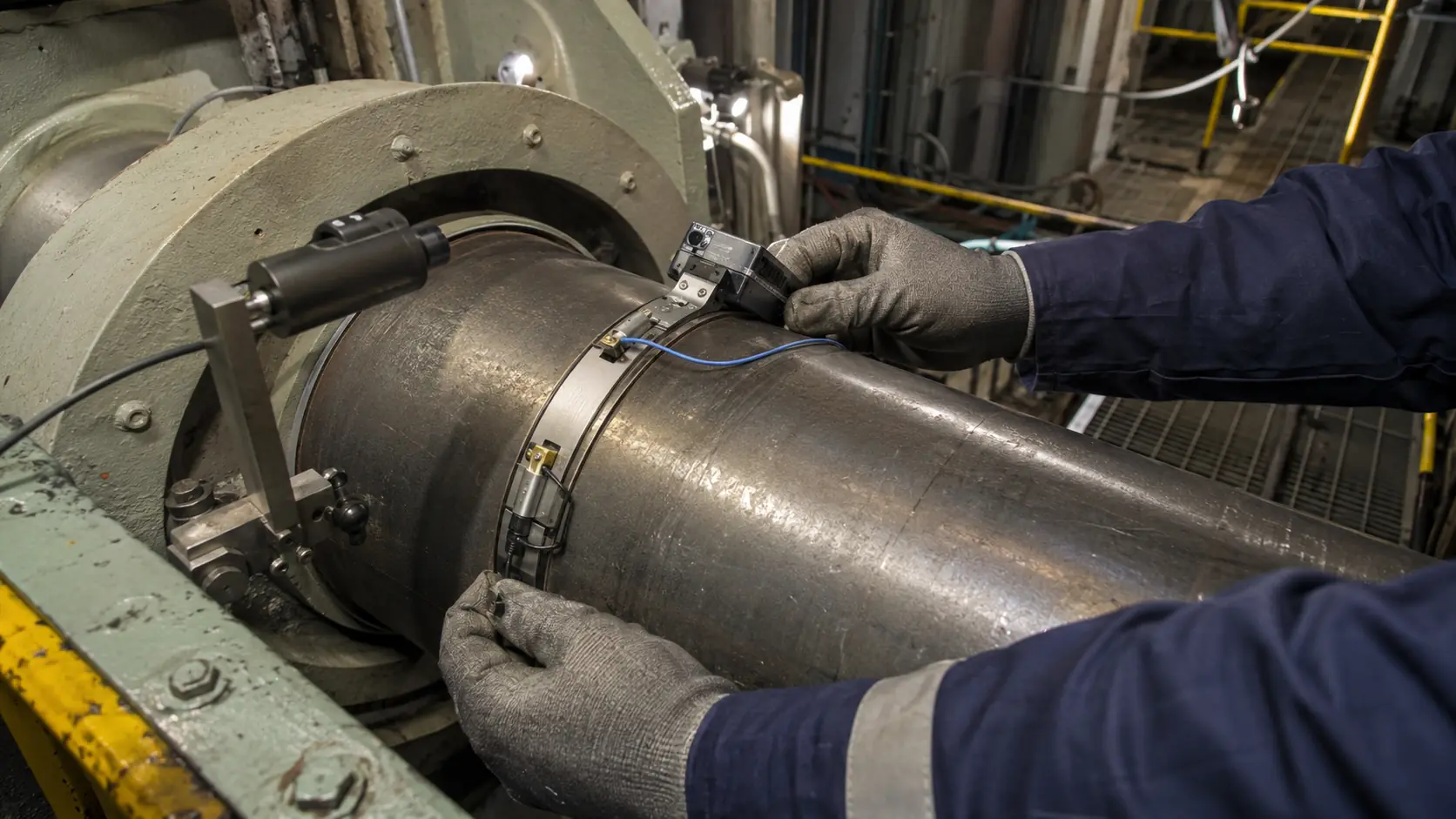
Torsional vibration is the cyclic twisting response of a propulsion or rotating system. It may not be visible as conventional casing vibration, yet excessive alternating torque can affect shafts, couplings, gears, dampers and crankshafts. Vessel Doctor supports planned measurement programmes that document torsional response across the required speed and load range.
VIBRATION SPECTRUMClear evidence→
VESSEL DOCTORMarine Torsional Vibration Measurement and Analysis
SURVEY PROFILEVibration & Dynamics
06/21
01
WHY THIS SURVEY MATTERS
Evidence before assumption.
Propulsion changes, engine tuning, propeller modifications, damper condition and system configuration can change torsional behaviour. Measurement is used to verify predicted critical speeds, investigate abnormal response and compare actual behaviour with approved calculations or manufacturer/class requirements.
02
MEASUREMENT SCOPE
What we measure.
- ✓Instantaneous rotational speed or angular displacement
- ✓Torsional oscillation and order components
- ✓Response across controlled speed sweeps
- ✓Load and operating-condition dependence
- ✓Critical-speed and resonance behaviour
- ✓Comparison with calculation, manufacturer or class criteria where supplied
03
TIMING & APPLICATION
When to request it.
Engine, propeller, gearbox, coupling or shaftline modification
Unexplained shaftline or coupling failures
Suspected damper problems
Changes to barred or restricted speed ranges
Class, yard, designer or manufacturer verification request
04
SURVEY PROCESS
A controlled route from plan to finding.
Define
Confirm the decision, vessel condition and evaluation basis.
Prepare
Agree locations, safe access, instruments and operating matrix.
Measure
Capture traceable data with conditions documented during measurement.
Interpret
Evaluate against the agreed basis and isolate meaningful patterns.
Report
Issue findings, limitations and focused next actions.
05
TECHNICAL DELIVERABLE
What you receive.
- ✓Approved or client-agreed test plan
- ✓Sensor configuration and operating log
- ✓Order-tracked plots and speed-response results
- ✓Identified critical regions
- ✓Comparison with supplied calculation or agreed acceptance basis
- ✓Technical findings and recommendation for specialist review where required
06
STANDARDS & PROJECT CRITERIA
The governing basis comes first.
Torsional acceptance is highly system-specific. Use the relevant classification-society rules, approved torsional-vibration calculation, engine/shaftline designer requirements and ISO 20283-4 where applicable. Do not invent a universal pass/fail value.
Important
Explore our standards directory↗Acceptance remains subject to the applicable flag administration, classification society, contract, vessel specification and authorised reviewing party.
ASIA + WORLDWIDE ATTENDANCE
Marine Torsional Vibration Measurement and Analysis wherever the vessel needs it.
Vessel Doctor coordinates this service for vessels in Singapore, India, Malaysia, Sri Lanka, Indonesia, Thailand, wider Asian maritime centres and ports worldwide. The scope can support technical managers, marine superintendents, ship agents, owners, operators, shipyards and consultants who need documented onboard evidence.
How clients describe this need: Projects may be described as marine torsional vibration measurement, ship shaft torsional test, propulsion vibration analysis, shaftline survey and barred-speed verification. Clients may also report that the propulsion train has restricted speeds, coupling or damper concerns, repeated shaftline failures or suspected twisting vibration. Depending on the technical question, the attendance may involve torsional testing, angular measurement, order analysis, survey, technical assessment, verification or diagnostics during newbuilding sea trials, repowering, propeller or engine changes, pre-delivery testing or a targeted failure investigation. We confirm the final scope from the vessel, operating condition, access, applicable criteria, measurement purpose and required reporting outcome.
Southeast AsiaMarine Torsional Vibration Measurement and Analysis in Singapore↗South AsiaMarine Torsional Vibration Measurement and Analysis in India↗Southeast AsiaMarine Torsional Vibration Measurement and Analysis in Malaysia↗South AsiaMarine Torsional Vibration Measurement and Analysis in Sri Lanka↗Southeast AsiaMarine Torsional Vibration Measurement and Analysis in Indonesia↗Southeast AsiaMarine Torsional Vibration Measurement and Analysis in Thailand↗Global coverageWorldwide Marine Torsional Vibration Measurement and Analysis↗
SERVICE FAQ
Questions project teams ask.
Every scope is confirmed against the actual vessel, timing and decision requirement.
01How is torsional vibration different from machinery casing vibration?+
Torsional vibration is angular oscillation within the rotating train; casing vibration is physical motion measured on the machine structure or bearings.
02Is an approved calculation required?+
It is strongly preferred for verification because measured response should be compared with the designed system and applicable class basis.
03Can torsional vibration be measured without stopping the vessel?+
Measurement normally requires a controlled operational test plan and safe sensor installation. Requirements depend on the selected measurement method.
04Can the survey change the barred speed range?+
Any change requires review and acceptance by the responsible designer, engine maker, class and/or flag authority as applicable.
TORSIONAL VIBRATION TEST PLAN
Measure twist against speed, order and operating state.
Marine torsional vibration measurement is different from casing or bearing vibration testing. The survey must resolve angular or strain response in the propulsion shafting, coupling, crankshaft or driven train against a reliable speed/order reference and an agreed calculation, class, commissioning or troubleshooting question.
Define the decision
Confirm whether the test supports calculation validation, sea-trial acceptance, barred-speed review, coupling investigation, retrofit, damage diagnosis or an owner condition check.
Assemble the train
Record engine firing arrangement, inertias, shaft and coupling stiffness, gear ratio, propeller or driven load, damper data and the approved calculation or maker limits.
Control speed and load
Plan steady holds and run-up/run-down sweeps with traceable RPM/order reference, safe measurement location, telemetry or optical method, channel checks and operating log.
Report the boundary
Compare measured response with the agreed calculation, permissible limits or diagnostic hypothesis; identify critical orders, speed ranges, uncertainty and any required repeat test.
| Project need | Evidence to capture | Important limitation |
|---|---|---|
| Validate a torsional-vibration calculation during sea trial | Approved calculation/model, defined shaft or coupling location, calibrated measurement chain, RPM/order reference, agreed loading curve, steady points and controlled sweeps. | Measured strain, twist, stress or torque must be compared on the same basis and location as the calculation. |
| Investigate vibration at one engine RPM | Order-tracked torsional response through the affected range, simultaneous casing/structural reference where useful, firing and load state, damper/coupling condition and repeatability. | A casing acceleration peak does not by itself prove excessive torsional stress. |
| Confirm barred or restricted speed range behaviour | Controlled passage through the range using the class-, maker- and safety-agreed procedure, response maxima, time in range and operating restrictions. | Do not enter or dwell in a restricted range without an approved trial plan. |
| Assess a coupling, damper, generator or retrofit change | Before/after configuration, component data, updated inertia/stiffness model, representative load cases and matching measurement locations. | A modification can move a natural frequency or change excitation; old acceptance evidence may not remain representative. |
| Support class, flag, maker or owner review | Named acceptance basis, witnessing and supplier-qualification requirements, instrument/calibration evidence, raw and processed results, uncertainty and signed operating record. | Project-specific report acceptance is not the same as blanket supplier approval. |
Measurement and reporting basis
ISO 20283-4:2012, confirmed current by ISO in 2023, covers measurement and evaluation of ship propulsion-machinery vibration. The exact torsional acceptance basis normally also depends on the vessel's classification rules, approved calculation, engine/shaft/coupling maker limits and trial programme. The final method must therefore be agreed before attendance rather than inferred from one general standard.
Information needed before mobilisation
Send the vessel and IMO number, propulsion or generator train diagram, engine and firing data, shaft/coupling/damper particulars, approved torsional calculation, maker limits, target measurement location, available drawings, instrumentation access, telemetry constraints, load/speed programme, barred-speed information, class/flag, witnessing requirement and decision deadline. Attendance can be assessed for berth, harbour trial, sea trial, commissioning, repair and retrofit projects in Singapore, Malaysia, India, Sri Lanka, Indonesia, Thailand, the Philippines, the Middle East, Asia-Pacific and worldwide.
Class and flag context
For ABS-, BV-, CCS-, CRS-, DNV-, IRS-, KR-, LR-, ClassNK-, PRS-, RINA- or Türk Loydu-classed vessels and major flag administrations, calculation approval, measurement witnessing, supplier qualification and report acceptance can differ by project. Confirm the route with the owner, yard, maker and attending surveyor. No class or flag approval is claimed.
START A TECHNICAL DISCUSSION
Plan your marine torsional vibration measurement and analysis.
Share the vessel, location, operating condition and reporting purpose. We will help shape a focused, technically defensible survey scope.