
Voluntary class notation or owner target
Environmental & Acceptance Testing · SERVICE 18
Underwater Radiated Noise Survey
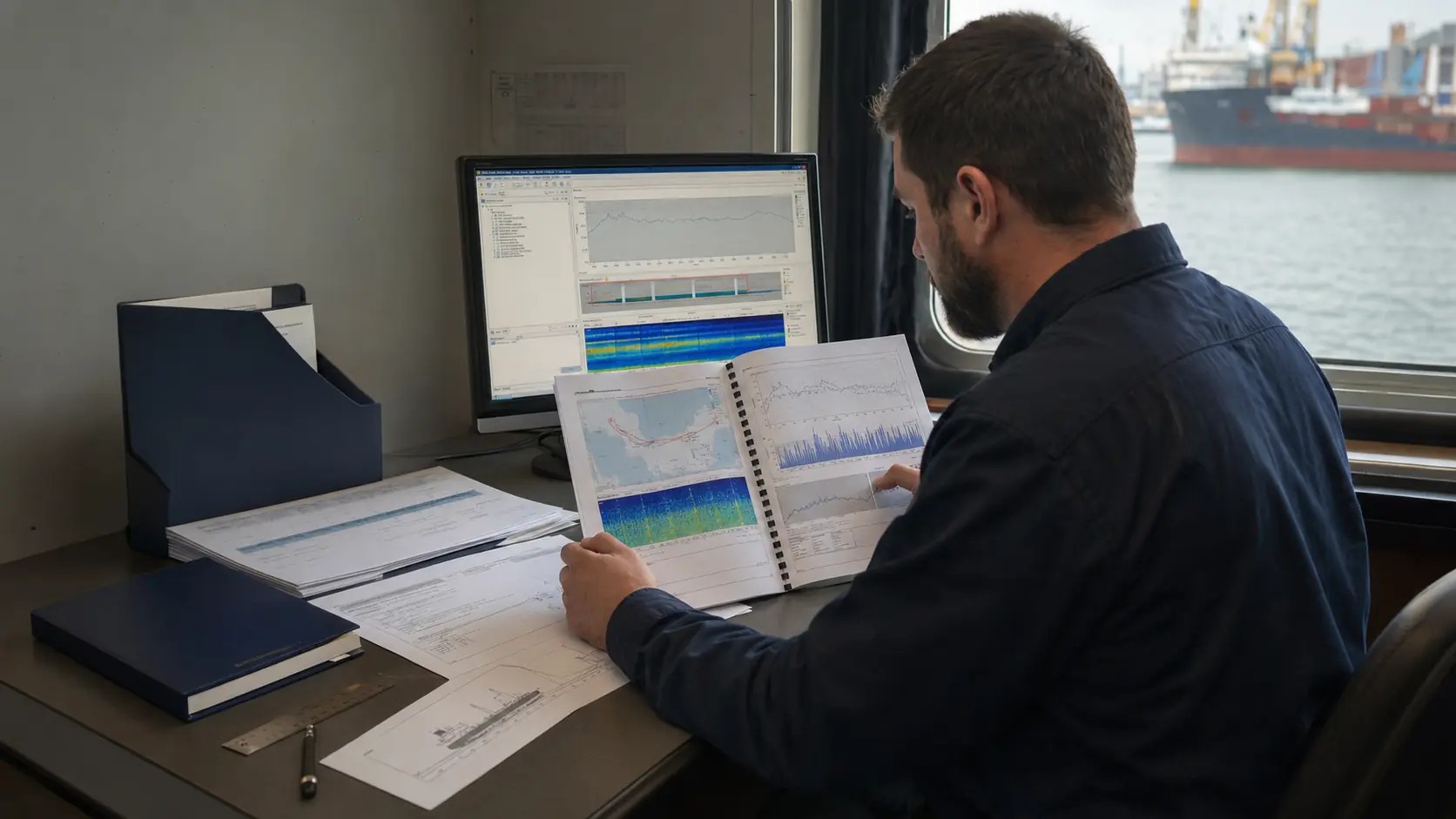
Propellers, propulsion machinery and onboard equipment radiate sound into the water. Underwater radiated noise is increasingly considered in vessel design, environmental programmes, research operations and voluntary class notations. Vessel Doctor supports carefully planned URN measurement campaigns with specialist partners, suitable instrumentation and documented operating conditions.
PERFORMANCE VERIFICATIONClear evidence→
VESSEL DOCTORUnderwater Radiated Noise Survey
SURVEY PROFILEEnvironmental & Acceptance Testing
18/21
01
WHY THIS SURVEY MATTERS
Evidence before assumption.
Underwater noise can change with propeller cavitation, speed, loading, water depth, machinery configuration and measurement geometry. Valid results require far more than placing a hydrophone beside a vessel; the test range, background, tracking and processing method must match the reporting purpose.
02
MEASUREMENT SCOPE
What we measure.
- ✓Frequency-resolved underwater sound pressure
- ✓Source-level estimates under the selected method
- ✓Vessel speed and operating condition
- ✓Background and self-noise
- ✓Narrowband or one-third-octave characteristics
- ✓Comparative runs before and after modifications
03
TIMING & APPLICATION
When to request it.
Research and survey-vessel requirements
Quieter-vessel design programme
Propeller or propulsion modification evaluation
Environmental impact or port study
Baseline for fleet decarbonisation/noise initiatives
04
SURVEY PROCESS
A controlled route from plan to finding.
Define
Confirm the decision, vessel condition and evaluation basis.
Prepare
Agree locations, safe access, instruments and operating matrix.
Measure
Capture traceable data with conditions documented during measurement.
Interpret
Evaluate against the agreed basis and isolate meaningful patterns.
Report
Issue findings, limitations and focused next actions.
05
TECHNICAL DELIVERABLE
What you receive.
- ✓Measurement concept and feasibility review
- ✓Test-range and operating-condition plan
- ✓Calibrated acoustic dataset
- ✓Processing and correction methodology
- ✓Results against the agreed reference basis
- ✓Recommendations for source investigation or mitigation
06
STANDARDS & PROJECT CRITERIA
The governing basis comes first.
Use the revised IMO guidelines for reduction of underwater radiated noise from shipping, including MEPC.1/Circ.906 where applicable, the relevant ISO 17208 series, class notation and project-specific criteria. Treat IMO guidance as voluntary unless made mandatory by another applicable requirement.
Important
Explore our standards directory↗Acceptance remains subject to the applicable flag administration, classification society, contract, vessel specification and authorised reviewing party.
ASIA + WORLDWIDE ATTENDANCE
Underwater Radiated Noise Survey wherever the vessel needs it.
Vessel Doctor coordinates this service for vessels in Singapore, India, Malaysia, Sri Lanka, Indonesia, Thailand, wider Asian maritime centres and ports worldwide. The scope can support technical managers, marine superintendents, ship agents, owners, operators, shipyards and consultants who need documented onboard evidence.
How clients describe this need: Projects may be described as underwater radiated noise survey, ship URN measurement, vessel underwater sound test, hydrophone survey and marine acoustic-signature assessment. Clients may also report that the project needs to understand how much sound the ship, propeller and onboard machinery radiate into the water. Depending on the technical question, the attendance may involve hydrophone measurement, underwater-noise testing, acoustic monitoring, source-level analysis, survey, assessment or verification on a suitable test range, during controlled sea trials, after propeller or propulsion changes, or for research, class or environmental programmes. We confirm the final scope from the vessel, operating condition, access, applicable criteria, measurement purpose and required reporting outcome.
Southeast AsiaUnderwater Radiated Noise Survey in Singapore↗South AsiaUnderwater Radiated Noise Survey in India↗Southeast AsiaUnderwater Radiated Noise Survey in Malaysia↗South AsiaUnderwater Radiated Noise Survey in Sri Lanka↗Southeast AsiaUnderwater Radiated Noise Survey in Indonesia↗Southeast AsiaUnderwater Radiated Noise Survey in Thailand↗Global coverageWorldwide Underwater Radiated Noise Survey↗
SERVICE FAQ
Questions project teams ask.
Every scope is confirmed against the actual vessel, timing and decision requirement.
01Can URN be measured in any port?+
Not reliably. Water depth, background noise, traffic, geometry and permissions may make a location unsuitable.
02Is underwater noise the same as onboard noise?+
No. They involve different propagation media, instrumentation, metrics and acceptance purposes.
03Does the IMO set a universal mandatory URN limit?+
The referenced IMO guidelines are generally voluntary; specific projects, ports, owners or class notations may set targets.
04Can you locate the source of excessive URN?+
Comparative runs and onboard vibration/noise measurements can help identify contributors, but complex source-path analysis may require additional modelling.
UNDERWATER-NOISE TRIAL PLAN
Make vessel speed, water depth and machinery state part of every result.
An underwater radiated noise survey, test or measurement is only comparable when the ship, hydrophone geometry, closest point of approach, water conditions, background sound and operating state are controlled and reported. The plan should first decide whether the need is a precision comparison, a shallow-water assessment, a design or acceptance trial, an environmental baseline or practical propeller and machinery troubleshooting.
Choose the decision
Define the required metric, frequency bands, comparison basis, acceptance target and whether the report supports design, sea trial, retrofit or an in-service investigation.
Qualify the water
Record depth, bathymetry, seabed, sound-speed profile, current, sea state, other traffic, ambient sound and the geometry available for repeatable runs.
Hold the operating state
Log speed through water and over ground, heading, draught, trim, propulsion mode, shaft or propeller speed, machinery configuration and closest approach.
Connect sound to the vessel
Compare repeat runs and operating states; add onboard vibration, RPM/order or machinery evidence when the decision is source diagnosis rather than only reporting radiated level.
| Buyer question | Evidence to plan | Decision boundary |
|---|---|---|
| What underwater sound does the vessel radiate at a stated operating condition? | Calibrated hydrophone chain, geometry, multiple controlled runs, speed and propulsion state, ambient/background measurement, water-depth and propagation data, decidecade-band results and uncertainty. | ISO 17208-1 precision deep-water results, ISO 17208-3 shallow-water results and a project-specific engineering survey are not automatically interchangeable. |
| Did a propeller, hull, machinery or operating change reduce URN? | Matched before/after draught, trim, speed, route, sea state, water condition, machinery lineup and measurement geometry, with repeatability and uncertainty retained. | An unmatched speed or site change can be larger than the treatment effect. |
| Why is radiated noise high at one speed or RPM? | Run matrix across speed, shaft rate and machinery states; tonal and broadband spectra; onboard accelerometer or airborne-noise correlation; propeller and hull condition information. | An external hydrophone result alone may not identify whether the dominant mechanism is cavitation, machinery transmission or flow noise. |
| Support newbuilding, retrofit, owner, class, flag or environmental review | Named criterion and edition, witness and data rules, test-site acceptance, run schedule, instrument calibration, traceable raw data, corrections, deviations and report route. | Project report acceptance is not blanket class, flag or service-supplier approval. |
Current method and management references
ISO 17208-1:2016, together with Amendment 1:2024, defines precision deep-water measurement under prescribed operating conditions. ISO 17208-3:2025 addresses shallow-water measurement and source-level calculation. The IMO revised underwater-noise guidelines, MEPC.1/Circ.906/Rev.1, provide management context; they do not create one universal pass/fail limit for every vessel. ISO 17208-2:2019, confirmed by ISO on 23 June 2026, is a separate source-level calculation route for far-field prediction, so radiated-noise level, source level and an environmental contour input should not be reported as interchangeable quantities.
Run-acceptance evidence pack
Before formal passes, agree the accepted-run rule and retain hydrophone sensitivity, recorder settings, timing synchronisation, sound-speed information, background sample, track and closest-point geometry. For every run, preserve speed through water and over ground, heading, draught, trim, shaft or propeller rate, pitch, propulsion mode, generator and auxiliary lineup and abnormal events. Report measured fact, correction and uncertainty before causal interpretation.
Information needed before mobilisation
Send the vessel and IMO number, hull and propeller particulars, draught and trim, target speeds or RPM, propulsion and machinery configurations, trial purpose, required standard or notation, candidate water area and depth, environmental restrictions, previous data, witnessing needs and reporting deadline. Attendance and equipment feasibility can be assessed for Singapore, Malaysia, India, Sri Lanka, Indonesia, Thailand, the Philippines, the Middle East, Asia-Pacific and worldwide.
Class and flag submission context
For ABS-, BV-, CCS-, CRS-, DNV-, IRS-, KR-, LR-, ClassNK-, PRS-, RINA- or Türk Loydu-classed vessels, including Singapore-, Panama-, Liberia-, Marshall Islands-, Bahamas-, Malta-, Cyprus-, Hong Kong- and Isle of Man-flagged ships, the owner or yard should confirm the notation, supplier qualification, witnessing, method and report-acceptance route with the attending surveyor or administration. No class, flag or supplier approval is claimed.
START A TECHNICAL DISCUSSION
Plan your underwater radiated noise survey.
Share the vessel, location, operating condition and reporting purpose. We will help shape a focused, technically defensible survey scope.