
PA announcements are audible but unclear
Noise & Acoustics · SERVICE 16
Onboard Reverberation and Speech Intelligibility Testing
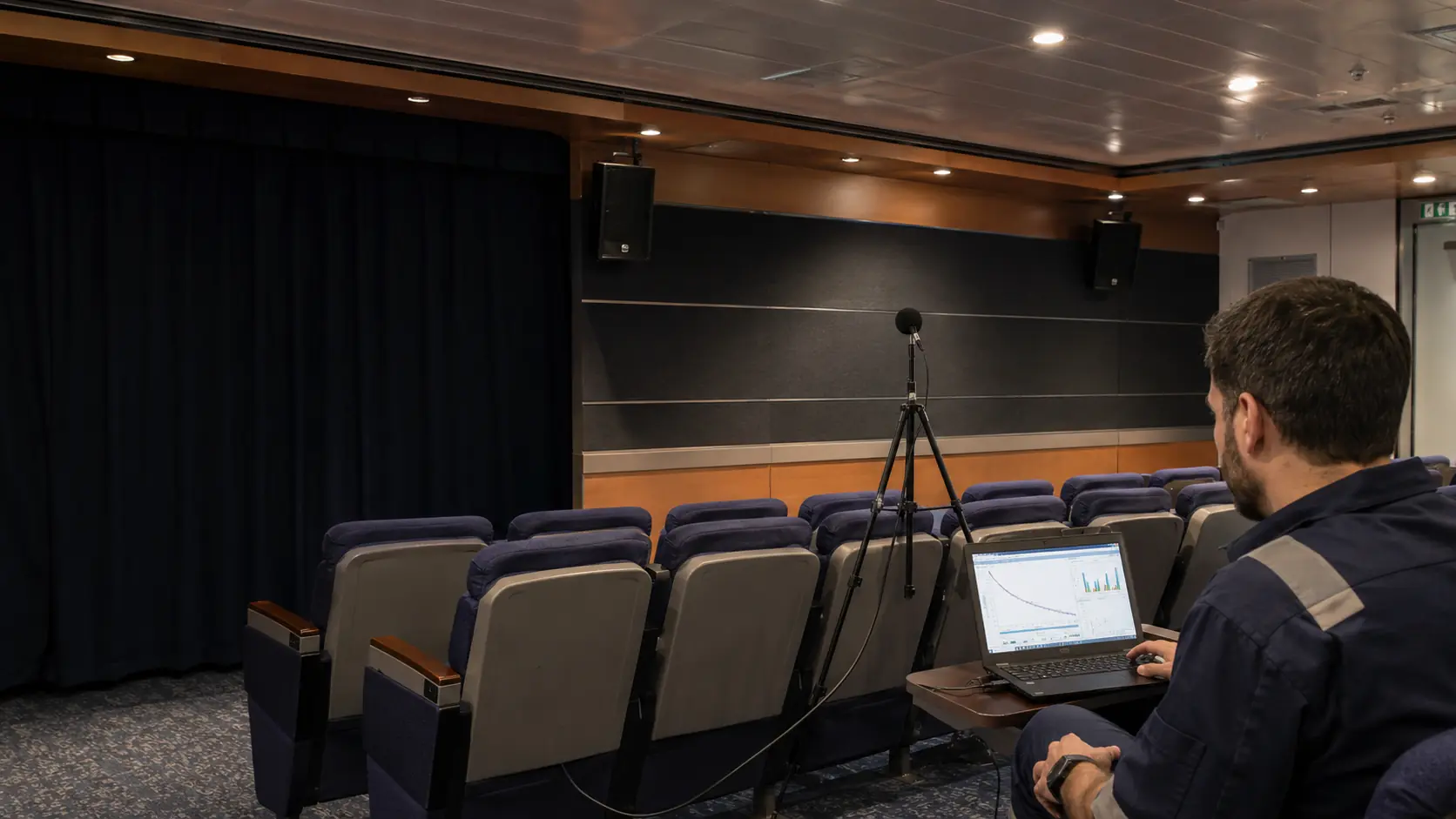
A message can be loud but difficult to understand when reflections blur syllables or background noise masks important information. Vessel Doctor measures room acoustic response and speech intelligibility in selected vessel spaces to support PA performance, passenger experience, control-room communication and acoustic troubleshooting.
ACOUSTIC FIELD MAPPINGClear evidence→
VESSEL DOCTOROnboard Reverberation and Speech Intelligibility Testing
SURVEY PROFILENoise & Acoustics
16/21
01
WHY THIS SURVEY MATTERS
Evidence before assumption.
Large public rooms, hard-finished spaces, stairwells, vehicle decks and control rooms can develop excessive reverberation. Measuring decay and intelligibility provides evidence for acoustic treatment, speaker adjustment and system design.
02
MEASUREMENT SCOPE
What we measure.
- ✓Reverberation time by frequency band
- ✓Background noise
- ✓Speech Transmission Index or agreed intelligibility metric
- ✓Level distribution and signal-to-noise relationship
- ✓Spatial variation across listening positions
- ✓Effect of doors, occupancy and operating conditions where relevant
03
TIMING & APPLICATION
When to request it.
Newbuilding public-space acoustic acceptance
Control-room or meeting-space communication problems
After interior finishes or speaker systems change
Before specifying acoustic absorption treatment
Verification after remedial work
04
SURVEY PROCESS
A controlled route from plan to finding.
Define
Confirm the decision, vessel condition and evaluation basis.
Prepare
Agree locations, safe access, instruments and operating matrix.
Measure
Capture traceable data with conditions documented during measurement.
Interpret
Evaluate against the agreed basis and isolate meaningful patterns.
Report
Issue findings, limitations and focused next actions.
05
TECHNICAL DELIVERABLE
What you receive.
- ✓Space and receiver-location plan
- ✓Reverberation and intelligibility results
- ✓Frequency and spatial analysis
- ✓Identification of masking or reflection problems
- ✓Recommendations for treatment, speaker zoning or level adjustment
- ✓Verification results when retesting is included
06
STANDARDS & PROJECT CRITERIA
The governing basis comes first.
Use applicable editions of ISO 3382 for reverberation-time measurement and IEC 60268-16 for STI where agreed, together with relevant SOLAS/IMO, flag, class and contract requirements. Select the method according to the space and reporting purpose.
Important
Explore our standards directory↗Acceptance remains subject to the applicable flag administration, classification society, contract, vessel specification and authorised reviewing party.
ASIA + WORLDWIDE ATTENDANCE
Onboard Reverberation and Speech Intelligibility Testing wherever the vessel needs it.
Vessel Doctor coordinates this service for vessels in Singapore, India, Malaysia, Sri Lanka, Indonesia, Thailand, wider Asian maritime centres and ports worldwide. The scope can support technical managers, marine superintendents, ship agents, owners, operators, shipyards and consultants who need documented onboard evidence.
How clients describe this need: Projects may be described as ship reverberation testing, vessel reverberation-time measurement, marine STI test, PA intelligibility survey and room-acoustic assessment. Clients may also report that announcements are loud but unclear, speech sounds blurred, or a room, stairwell, vehicle deck or control space has too much echo. Depending on the technical question, the attendance may involve reverberation testing, RT measurement, STI testing, intelligibility assessment, acoustic evaluation or corrective-work verification during PA commissioning, newbuilding acceptance, interior modification, shipyard testing or an operational communication investigation. We confirm the final scope from the vessel, operating condition, access, applicable criteria, measurement purpose and required reporting outcome.
Southeast AsiaOnboard Reverberation and Speech Intelligibility Testing in Singapore↗South AsiaOnboard Reverberation and Speech Intelligibility Testing in India↗Southeast AsiaOnboard Reverberation and Speech Intelligibility Testing in Malaysia↗South AsiaOnboard Reverberation and Speech Intelligibility Testing in Sri Lanka↗Southeast AsiaOnboard Reverberation and Speech Intelligibility Testing in Indonesia↗Southeast AsiaOnboard Reverberation and Speech Intelligibility Testing in Thailand↗Global coverageWorldwide Onboard Reverberation and Speech Intelligibility Testing↗
SERVICE FAQ
Questions project teams ask.
Every scope is confirmed against the actual vessel, timing and decision requirement.
01What is reverberation time?+
It describes how quickly sound decays in a space and indicates how reflective or absorptive the room is.
02Does a high PA level guarantee good intelligibility?+
No. Background noise, reverberation, distortion and speaker coverage can reduce understanding.
03Can testing be performed without passengers or crew present?+
Yes, but occupancy can change room absorption. The test condition must match the required assessment basis.
04Can you design the acoustic treatment?+
We can provide target areas and performance recommendations; detailed architectural or electroacoustic design can be added through an agreed specialist scope.
START A TECHNICAL DISCUSSION
Plan your onboard reverberation and speech intelligibility testing.
Share the vessel, location, operating condition and reporting purpose. We will help shape a focused, technically defensible survey scope.
ROOM ACOUSTIC DECISION PATH
Separate echo, masking, coverage and system distortion.
Ship reverberation-time measurement and speech-intelligibility testing answer related but different questions. Reverberation describes sound decay in the space; STI or STIPA evaluates how the transmission path and acoustic environment affect understood speech.
Describe the room
Record dimensions, finishes, doors, curtains, seating, occupancy, HVAC and nearby vessel machinery because each can change decay or masking.
Define the signal path
Confirm whether the decision concerns natural speech, a loudspeaker, a microphone-to-PA path or a recorded announcement and document the test source.
Sample spatial variation
Select listening positions that represent near, far, obstructed and complaint locations rather than relying on one convenient reading.
Link evidence to treatment
Use decay, background, level, STI and observations together to decide whether absorption, zoning, aiming, level balance or system checks are justified.
| Decision | Primary evidence | Important limitation |
|---|---|---|
| Does this onboard space have excessive echo? | Reverberation time by relevant frequency band using an agreed ISO 3382 method and documented room state. | One broadband number can hide frequency-specific decay and local variation. |
| Can a listener understand the announcement? | STI/STIPA or another agreed intelligibility metric across representative listening positions and the intended signal path. | A high sound level alone does not establish intelligibility. |
| Is background noise masking speech? | Background spectrum and operating-state record compared with the announcement or test condition. | Measurements taken with quiet machinery or HVAC may not represent service conditions. |
| Did acoustic treatment or PA adjustment work? | Repeat the same method, source, receiver positions and operating condition before and after corrective work. | Changed doors, occupancy or system settings can invalidate a simple comparison. |
Method, class and acceptance context
The applicable ISO 3382 method, IEC 60268-16 procedure, vessel specification, class rule, flag requirement and acceptance criterion must be selected for the actual space and decision. Record calibration status, source arrangement, receiver grid, room condition, background noise and any correction applied. For classed or flagged vessels, confirm the report-review and witnessing route with the owner, yard and attending surveyor. This is technical submission context, not an approval claim.
Technical planning guide: Read the onboard reverberation, STI and STIPA measurement guide.