
Crew or passenger complaints
Habitability & Environmental Quality · SERVICE 04
Onboard Indoor Air Quality Testing
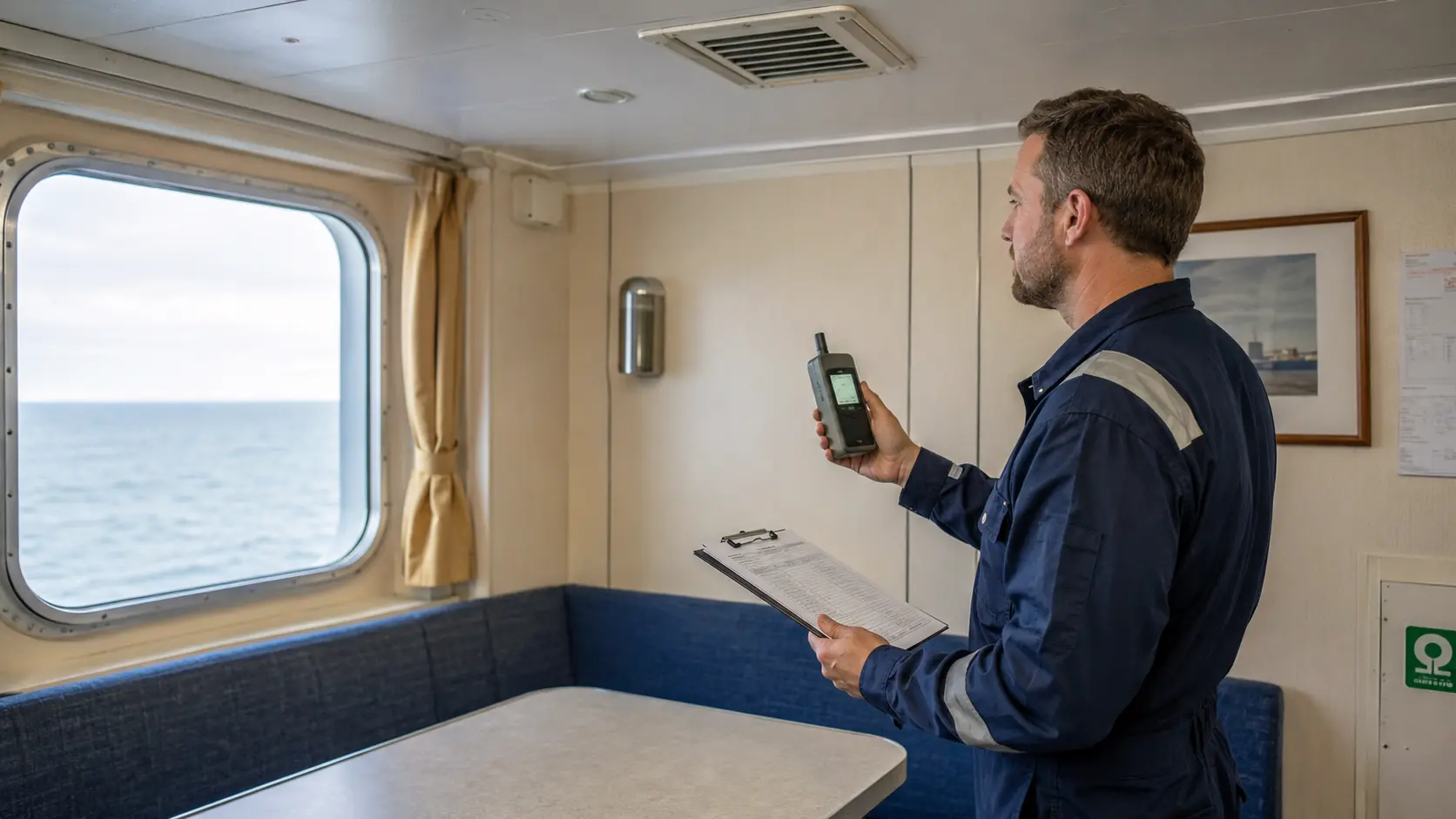
The quality of air inside a vessel affects alertness, comfort, wellbeing and confidence in the accommodation environment. Enclosed spaces can be influenced by ventilation performance, occupancy, cleaning chemicals, maintenance activities, engine exhaust ingress, cargo-related sources, moisture and microbial growth. Vessel Doctor develops vessel-specific IAQ scopes for accommodation, offices, control rooms, medical rooms and other occupied spaces.
ENVIRONMENTAL QUALITYClear evidence→
VESSEL DOCTOROnboard Indoor Air Quality Testing
SURVEY PROFILEHabitability & Environmental Quality
04/21
01
WHY THIS SURVEY MATTERS
Evidence before assumption.
Symptoms such as odour, headache, irritation, fatigue or stuffiness do not identify a single pollutant. A structured investigation combines measured contaminants, ventilation indicators, occupancy and observations to build a defensible picture of the indoor environment.
02
MEASUREMENT SCOPE
What we measure.
- ✓Carbon dioxide and carbon monoxide
- ✓Temperature and relative humidity
- ✓PM2.5, PM10 and other particulate fractions where required
- ✓Total volatile organic compounds
- ✓Formaldehyde and selected chemical parameters
- ✓Air velocity and ventilation indicators
- ✓Microbial air or surface parameters where included
- ✓Differential pressure or exhaust-ingress indicators when relevant
03
TIMING & APPLICATION
When to request it.
Persistent odour, irritation, condensation or visible mould
After refurbishment, painting or chemical treatment
Before delivery of a passenger or accommodation-intensive vessel
Following suspected exhaust or cargo-vapour ingress
As part of a habitability or HVAC investigation
04
SURVEY PROCESS
A controlled route from plan to finding.
Define
Confirm the decision, vessel condition and evaluation basis.
Prepare
Agree locations, safe access, instruments and operating matrix.
Measure
Capture traceable data with conditions documented during measurement.
Interpret
Evaluate against the agreed basis and isolate meaningful patterns.
Report
Issue findings, limitations and focused next actions.
05
TECHNICAL DELIVERABLE
What you receive.
- ✓Sampling strategy and location plan
- ✓Instrument and laboratory method details
- ✓Parameter-by-parameter results
- ✓Comparison with the agreed guideline or specification
- ✓Observations on ventilation, occupancy and potential sources
- ✓Practical corrective and verification recommendations
06
STANDARDS & PROJECT CRITERIA
The governing basis comes first.
Apply the relevant flag, class, owner and project requirements together with appropriate ISO 16000-series methods, exposure/IAQ guidance and accredited laboratory methods where sampling is required. Do not state that one universal IAQ limit applies to every vessel or jurisdiction.
Important
Explore our standards directory↗Acceptance remains subject to the applicable flag administration, classification society, contract, vessel specification and authorised reviewing party.
ASIA + WORLDWIDE ATTENDANCE
Onboard Indoor Air Quality Testing wherever the vessel needs it.
Vessel Doctor coordinates this service for vessels in Singapore, India, Malaysia, Sri Lanka, Indonesia, Thailand, wider Asian maritime centres and ports worldwide. The scope can support technical managers, marine superintendents, ship agents, owners, operators, shipyards and consultants who need documented onboard evidence.
How clients describe this need: Projects may be described as onboard indoor air quality testing, ship IAQ survey, vessel air-quality measurement, marine air monitoring and accommodation air assessment. Clients may also report that cabins feel stuffy, smell unusual or have dust, fumes, high carbon dioxide, irritation, condensation or suspected mould. Depending on the technical question, the attendance may involve air-quality testing, IAQ measurement, monitoring, inspection, sampling, ventilation assessment or laboratory analysis before delivery, after refurbishment, during occupancy, in port or shipyard, or while investigating crew and passenger complaints. We confirm the final scope from the vessel, operating condition, access, applicable criteria, measurement purpose and required reporting outcome.
Southeast AsiaOnboard Indoor Air Quality Testing in Singapore↗South AsiaOnboard Indoor Air Quality Testing in India↗Southeast AsiaOnboard Indoor Air Quality Testing in Malaysia↗South AsiaOnboard Indoor Air Quality Testing in Sri Lanka↗Southeast AsiaOnboard Indoor Air Quality Testing in Indonesia↗Southeast AsiaOnboard Indoor Air Quality Testing in Thailand↗Global coverageWorldwide Onboard Indoor Air Quality Testing↗
SERVICE FAQ
Questions project teams ask.
Every scope is confirmed against the actual vessel, timing and decision requirement.
01Which parameters should be tested?+
The scope depends on symptoms, vessel activity, materials, ventilation and suspected sources. A targeted scope is usually more useful than testing every available parameter.
02How long does IAQ testing take?+
It depends on vessel size, number of spaces, operating condition and whether laboratory sampling is required.
03Can you investigate mould?+
Yes, an investigation may include moisture observations, microbial sampling and ventilation assessment where technically appropriate.
04Can testing be done while accommodation is occupied?+
Often yes; representative occupancy can improve interpretation, provided sampling does not disrupt safe operations.
START A TECHNICAL DISCUSSION
Plan your onboard indoor air quality testing.
Share the vessel, location, operating condition and reporting purpose. We will help shape a focused, technically defensible survey scope.
SHIP IAQ INVESTIGATION PLAN
Start with the complaint, then select the evidence.
Onboard indoor air quality testing should not begin with the same fixed parameter list for every vessel. A useful ship IAQ survey links the affected spaces, timing, occupancy, ventilation state and suspected source to the measurements or samples needed for the decision.
Define what happens
Record stuffiness, odour, irritation, dust, condensation, visible growth or suspected exhaust ingress, including when and where the condition appears.
Make the test representative
Document occupancy, HVAC mode, doors, vessel activity, machinery, wind, nearby exhausts, cleaning, coating or cargo work and time since the last change.
Choose targeted evidence
Select direct-reading instruments, outdoor or reference locations and laboratory samples according to the hypothesis rather than collecting unrelated data.
Connect cause and response
Compare spaces, time periods and ventilation conditions to distinguish an indoor source, outdoor intake, transfer route, moisture problem or inadequate dilution.
| Buyer or crew report | Useful first measurements | Interpretation safeguard |
|---|---|---|
| Cabin air feels stuffy or occupants report fatigue | Carbon-dioxide trend, occupancy, temperature, humidity, ventilation state and, where needed, supply/outdoor-air performance. | Carbon dioxide is a ventilation and occupancy indicator; it does not identify every contaminant. |
| Odour or fumes appear only during certain operations | Time-resolved observations, VOC screening or targeted sampling, carbon monoxide where relevant, intake location, pressure/transfer checks and machinery or cargo activity. | A short reading outside the complaint period may miss an intermittent source. |
| Dust, particles or suspected exhaust ingress | PM2.5/PM10 or agreed particle fractions, indoor/outdoor comparison, source activity, filter condition and intake/pressure observations. | Particle size and source matter; a total particle number alone may not answer the exposure question. |
| Condensation, dampness or suspected mould | Temperature, relative humidity, surface condition, moisture investigation, airflow and targeted microbial sampling only where justified. | A microbial result without moisture, location and ventilation context cannot establish the cause. |
| Post-refurbishment or pre-delivery accommodation check | Material/activity review, VOC or formaldehyde scope where relevant, particles, ventilation indicators, thermal conditions and representative occupied-space plan. | Specify the agreed project or guideline basis; one building IAQ limit is not automatically a vessel requirement. |
Class, flag and country context
For ABS-, DNV-, Lloyd's Register-, Bureau Veritas-, RINA-, ClassNK- or other classed vessels, and for Singapore-, Panama-, Liberia-, Marshall Islands-, Bahamas-, Malta-, Cyprus-, Hong Kong- or Isle of Man-flagged ships, confirm whether the work supports habitability, a notation, owner policy, an occupational investigation, contract acceptance or ordinary troubleshooting. ISO 16000 methods, Singapore SS 554:2026 or another national IAQ reference apply only when technically and contractually appropriate to the actual scope. Qualification and acceptance depend on class, flag, contract and the reviewing party. This is not an approval claim.