
To establish a new predictive-maintenance programme
Hull & Machinery Condition · SERVICE 11
Vessel Machinery Condition Monitoring
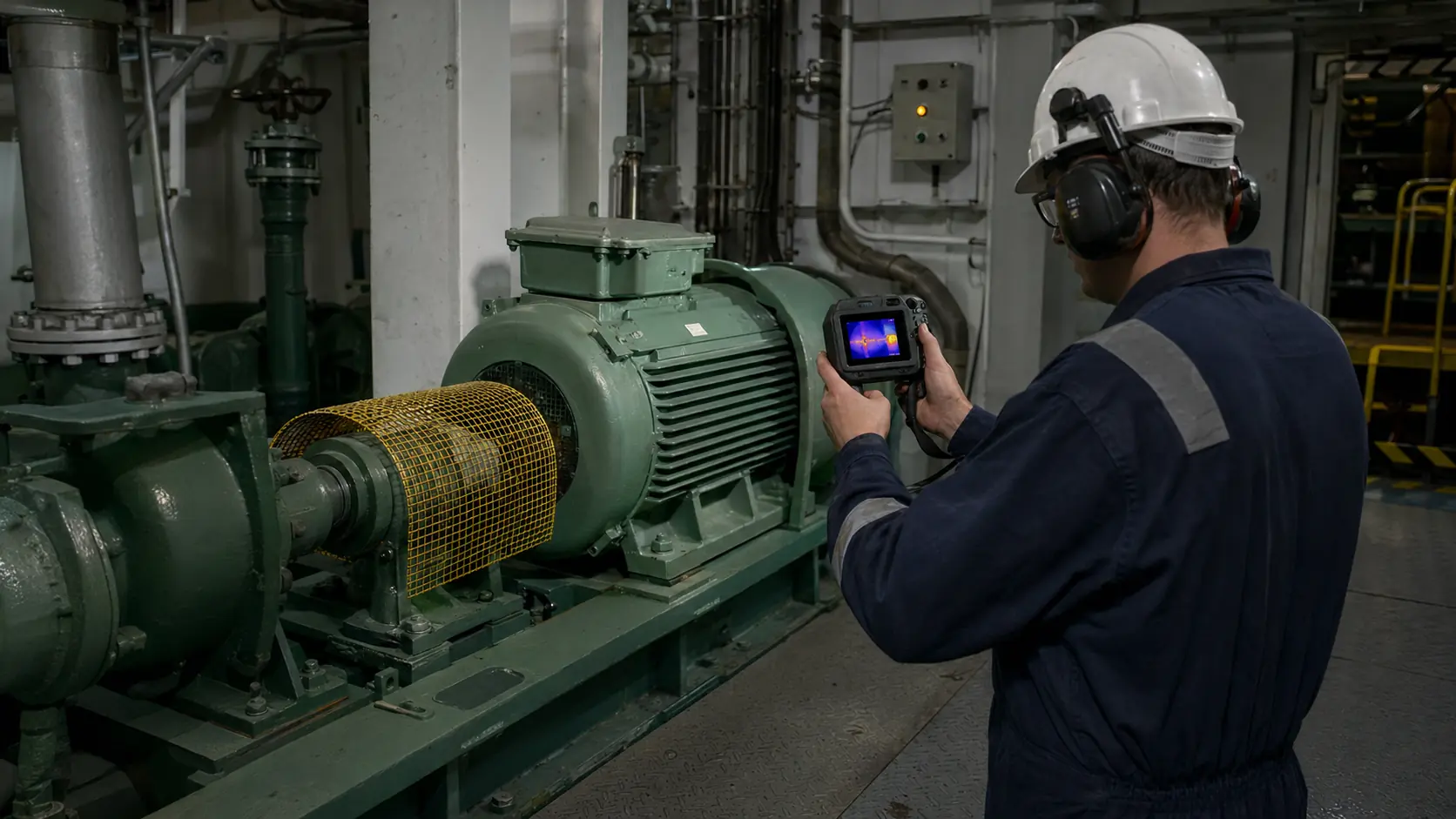
Condition monitoring converts recurring machinery data into an early-warning system for maintenance. Vessel Doctor helps technical teams establish measurement points, reliable baselines and repeatable survey routines for critical onboard assets, then interprets changes before they become costly failures.
STRUCTURAL CONDITIONClear evidence→
VESSEL DOCTORVessel Machinery Condition Monitoring
SURVEY PROFILEHull & Machinery Condition
11/21
01
WHY THIS SURVEY MATTERS
Evidence before assumption.
02
MEASUREMENT SCOPE
What we measure.
- ✓Vibration condition and spectral trends
- ✓Bearing and casing temperature
- ✓Lubricant and wear-debris results where included
- ✓Infrared thermography where technically suitable
- ✓Operating load, speed and process variables
- ✓Maintenance history and repeat failure patterns
- ✓Criticality and measurement frequency
03
TIMING & APPLICATION
When to request it.
After overhaul or equipment replacement
For recurrent machinery failures
Before dry dock or maintenance planning
When fixed monitoring alarms need portable verification
For fleet-wide condition baselines
04
SURVEY PROCESS
A controlled route from plan to finding.
Define
Confirm the decision, vessel condition and evaluation basis.
Prepare
Agree locations, safe access, instruments and operating matrix.
Measure
Capture traceable data with conditions documented during measurement.
Interpret
Evaluate against the agreed basis and isolate meaningful patterns.
Report
Issue findings, limitations and focused next actions.
05
TECHNICAL DELIVERABLE
What you receive.
- ✓Asset and criticality register for the agreed scope
- ✓Repeatable measurement-point map
- ✓Baseline and alarm/trend philosophy
- ✓Condition findings by asset
- ✓Priority-based maintenance recommendations
- ✓Follow-up interval and data-quality recommendations
06
STANDARDS & PROJECT CRITERIA
The governing basis comes first.
Use ISO 17359 condition-monitoring principles, applicable ISO 20816/20283 vibration guidance, manufacturer recommendations, class rules and vessel-specific baselines. Techniques should be selected according to likely failure mode, not added merely for quantity.
Important
Explore our standards directory↗Acceptance remains subject to the applicable flag administration, classification society, contract, vessel specification and authorised reviewing party.
ASIA + WORLDWIDE ATTENDANCE
Vessel Machinery Condition Monitoring wherever the vessel needs it.
Vessel Doctor coordinates this service for vessels in Singapore, India, Malaysia, Sri Lanka, Indonesia, Thailand, wider Asian maritime centres and ports worldwide. The scope can support technical managers, marine superintendents, ship agents, owners, operators, shipyards and consultants who need documented onboard evidence.
How clients describe this need: Projects may be described as vessel machinery condition monitoring, ship machine-health assessment, marine predictive maintenance, equipment diagnostics and trend analysis. Clients may also report that the technical team wants early warning that critical machinery is deteriorating before it fails. Depending on the technical question, the attendance may involve condition monitoring, vibration and temperature measurement, health check, inspection, trend evaluation, diagnostics or predictive analysis for one vessel or a fleet, after overhaul, before dry dock, during routine operation or when fixed alarms need independent verification. We confirm the final scope from the vessel, operating condition, access, applicable criteria, measurement purpose and required reporting outcome.
Southeast AsiaVessel Machinery Condition Monitoring in Singapore↗South AsiaVessel Machinery Condition Monitoring in India↗Southeast AsiaVessel Machinery Condition Monitoring in Malaysia↗South AsiaVessel Machinery Condition Monitoring in Sri Lanka↗Southeast AsiaVessel Machinery Condition Monitoring in Indonesia↗Southeast AsiaVessel Machinery Condition Monitoring in Thailand↗Global coverageWorldwide Vessel Machinery Condition Monitoring↗
SERVICE FAQ
Questions project teams ask.
Every scope is confirmed against the actual vessel, timing and decision requirement.
01Is condition monitoring a replacement for planned maintenance?+
Not automatically. It supports risk-informed maintenance and must be integrated with maker, class and company requirements.
02How often should measurements be repeated?+
Frequency depends on equipment criticality, failure behaviour, operating hours and existing condition.
03Can you monitor an entire fleet?+
Yes, with standardised asset naming, measurement points, operating records and reporting rules.
04Do you install permanent sensors?+
The initial service can use portable measurements. Permanent monitoring can be evaluated as a separate engineered scope.
START A TECHNICAL DISCUSSION
Plan your vessel machinery condition monitoring.
Share the vessel, location, operating condition and reporting purpose. We will help shape a focused, technically defensible survey scope.
MACHINERY HEALTH DECISION PATH
Turn vessel machinery data into a maintenance decision.
Vessel machinery health diagnostics is not one isolated reading. A defensible condition-monitoring programme connects repeatable measurements, operating state, change over time, probable failure modes and a clear maintenance response.
Define normal
Register the asset, criticality, measurement points, speed, load, direction and healthy operating condition so future measurements are comparable.
Find meaningful change
Trend vibration, temperature, oil or wear evidence and process variables. Separate a real condition change from altered load, RPM or data quality.
Test the failure hypothesis
Use spectra, waveforms, phase, enveloping, thermography, lubricant evidence or inspection only when the suspected failure mode justifies the technique.
Set the next action
State urgency, confidence, operating limitation, inspection or maintenance action, verification measurement and the next monitoring interval.
| Operational question | Best-fit scope | Decision evidence |
|---|---|---|
| Is this machine deteriorating over weeks or months? | Periodic or continuous machinery condition monitoring with repeatable points and operating states. | Baseline, trend, alert rationale, condition finding and next interval. |
| Why is the machine vibrating, noisy or repeatedly failing now? | Marine machinery vibration testing and diagnostics under controlled load and speed comparisons. | Spectra, waveforms, probable fault indicators, confidence and targeted checks. |
| Is an overhauled or replaced machine acceptable? | Post-maintenance verification or acceptance measurement against the agreed manufacturer, project or applicable standard basis. | Operating matrix, measured values, comparison basis and exceptions. |
| Which assets should enter the programme first? | Criticality review based on safety, redundancy, failure consequence, repair lead time and detectability. | Prioritised asset register and monitoring method by likely failure mode. |
Classed-vessel and flag-review context
For vessels classed by ABS, DNV, Lloyd’s Register, Bureau Veritas, RINA, ClassNK or another society, and for Singapore-, Panama-, Liberia-, Marshall Islands-, Bahamas-, Malta-, Cyprus-, Hong Kong- or Isle of Man-flagged vessels, confirm whether the work is ordinary maintenance diagnostics, a class-notation function, an approved service-supplier activity or evidence for a specific survey. Qualification and acceptance depend on the exact scope, vessel, class, flag, contract and attending surveyor. This is not an approval claim. Review the standards directory.
Technical planning guide: Read the baseline, trending and alarm-decision guide.