
Define
Confirm the vessel, installed system, spaces, operating condition, criteria and reporting purpose.
Habitability & Environmental Quality · SERVICE 20
Adequate illumination supports safe movement, visual tasks, machinery operation, maintenance and emergency response. Vessel Doctor measures light levels at defined locations and working planes, documents the operating condition and compares the results with the criteria agreed for the vessel and project.
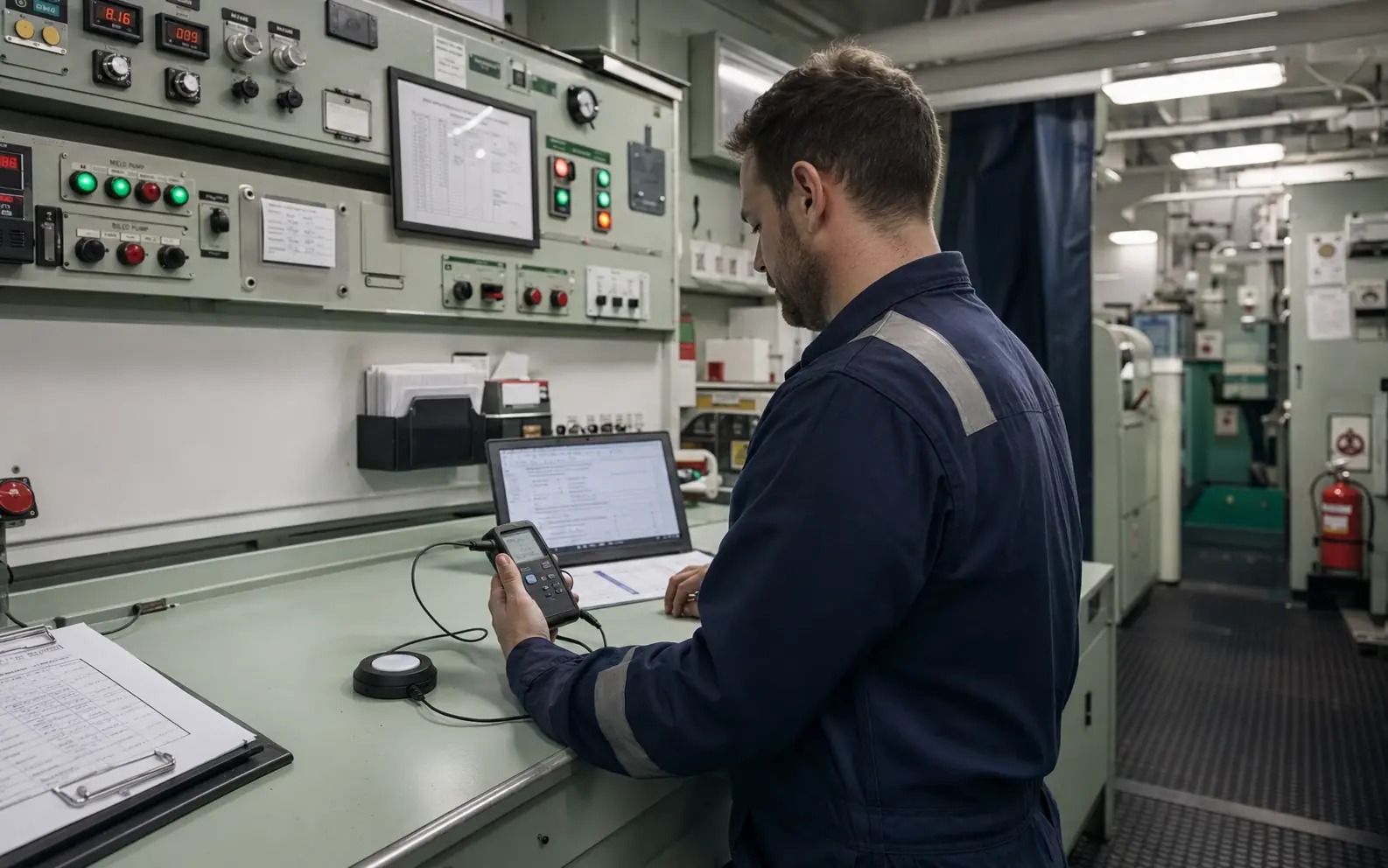 LUX DISTRIBUTION
01
WHY THIS SURVEY MATTERS
A space may appear bright while still containing poorly illuminated controls, shadowed work surfaces, dark stairs or uneven passageways. A documented survey distinguishes general impressions from repeatable lux measurements and identifies where further review or corrective action is required.
02
MEASUREMENT SCOPE
03
WHEN TO REQUEST IT
04
SURVEY PROCESS
Confirm the vessel, installed system, spaces, operating condition, criteria and reporting purpose.
Agree locations, power or charging condition, access, instrumentation and safety requirements.
Capture repeatable readings and observations under documented conditions.
Compare the evidence with the agreed vessel-specific requirement and recorded limitations.
Deliver clear findings, priorities and practical recommendations for the next action.
05
REPORTING OUTPUT
06
APPLICABLE BASIS
There is no single universal lux limit for every vessel space. The applicable criteria must be confirmed from the vessel type, flag, classification requirements, contractual specification, occupational guidance and intended visual task. The report identifies the agreed basis and avoids applying unrelated shore-based criteria without review.
Clients may describe this requirement as a ship light survey, onboard illumination test, vessel lux measurement, marine lighting inspection, shipboard light-level assessment, lighting adequacy check or emergency-lighting measurement.
ASIA + WORLDWIDE ATTENDANCE
Attendance can be coordinated for Singapore, India, Malaysia, Sri Lanka, Indonesia, Thailand, wider Asian maritime centres and ports worldwide, subject to scope, feasibility and applicable requirements.
SERVICE FAQ
Every scope is confirmed against the actual vessel, installation and decision requirement.
No. A general illumination survey measures lighting for tasks, movement and selected operational conditions. Low-location lighting is a specialised escape-route marking system with separate requirements.
The operating condition is agreed before attendance. Normal, emergency or selected lighting configurations can be included when safe access, vessel procedures and the project purpose permit.
Usually not. Appropriate criteria depend on the space, visual task, vessel specification and governing requirement.
A calibrated illuminance meter suitable for the agreed measurement range and method is used, with instrument details recorded in the report.
SHIPBOARD LIGHTING TEST PLAN
A ship illumination survey, lux test or lighting measurement should show whether people can safely see the route, control, gauge, work surface or accommodation task that matters. The plan records the measurement plane and grid, luminaire and daylight state, normal or emergency supply, obstructions and maintenance condition before comparing illuminance and uniformity with the vessel-specific requirement.
Confirm the space, task, working plane, required average or minimum illuminance, uniformity method, operating supply and any emergency-lighting duration requirement.
Record daylight exclusion or contribution, lamp warm-up, dimming, doors, temporary lights, failed fittings, dirt, shadows, voltage and generator or emergency-source state.
Position a suitable calibrated lux meter at agreed horizontal, vertical or task planes without shading the sensor, then retain location IDs and exceptions.
Ordinary illumination, emergency lighting and low-location escape-route lighting have different functions and evidence; one spot lux reading cannot close all three.
| Vessel question | Measurement evidence | Important limitation |
|---|---|---|
| Light level is low or uneven in a machinery space, workshop, bridge, galley, office, cabin, stair or passageway | Agreed task or floor-plane grid, average and minimum lux, uniformity calculation where specified, shadows, obstructions, failed or dirty fittings, daylight and normal-supply state. | A single high reading beneath one luminaire can hide dark working areas and unsafe routes. |
| Verify newbuilding, retrofit or post-repair lighting | Room and luminaire schedule, drawing-based points, installed control settings, matched before/after grid, supply condition, deviations and photographic location record. | Design calculations, installed lux measurements and subjective glare review answer different questions. |
| Confirm selected emergency-lighting performance | Defined loss-of-normal-power condition, emergency source, changeover observation, agreed points, measured lux and required duration evidence when included in the scope. | A short functional lux check does not prove full battery endurance unless duration testing is expressly included. |
| Support owner, yard, class or flag acceptance | Named rule, contract or accommodation criterion; vessel spaces and task planes; calibrated meter details; operating state; raw results; non-conformities; retest and report route. | Ordinary illumination testing does not replace a dedicated low-location-lighting luminance survey. |
The Maritime Labour Convention accommodation guidance includes shipboard lighting provisions. IEC 60092-306:2022 applies to ship luminaires and lighting accessories, but it does not replace the project-specific illuminance acceptance basis. The applicable lux values and measurement planes may instead come from the vessel specification, class rules, flag instructions, offshore standard, owner criteria or contract. The exact document, edition, spaces, supply condition and acceptance rule must therefore be agreed before the test.
Agree the horizontal, vertical or task plane and retain every point identifier, not only the average. Record normal or emergency supply, voltage where relevant, dimming, warm-up, daylight, doors, temporary lights, failed or dirty fittings, diffusers, shadows and obstructions. Where uniformity is required, state the formula and exact grid. Retest repairs at the same points and keep endurance testing separate from a short emergency-lighting functional check.
Send the vessel and IMO number, spaces and reported dark areas, lighting and emergency-power drawings, luminaire schedule, required criteria, task heights or measurement planes, normal and emergency supply arrangement, daylight restrictions, dimming settings, recent retrofit or failures, witnessing needs and deadline. Attendance can be assessed at berth, anchorage, port, harbour, shipyard or dry dock and during commissioning, pre-delivery, acceptance or in-service investigation across the same genuine Asia-Pacific and worldwide coverage.
For classed or internationally flagged vessels, confirm the required spaces, operating condition, emergency-source test, supplier qualification, witnessing and report route with the owner, yard and attending surveyor or administration. This service content does not claim ABS, BV, CCS, CRS, DNV, IRS, KR, LR, ClassNK, PRS, RINA, Türk Loydu or flag approval.
PLAN THE RIGHT MEASUREMENT
Share the vessel type, location, system information, schedule, governing requirement and required deliverable. We will review the appropriate measurement scope and attendance requirements.