
Strong vibration at a particular RPM
Vibration & Dynamics · SERVICE 14
Structural and Hull Vibration Survey
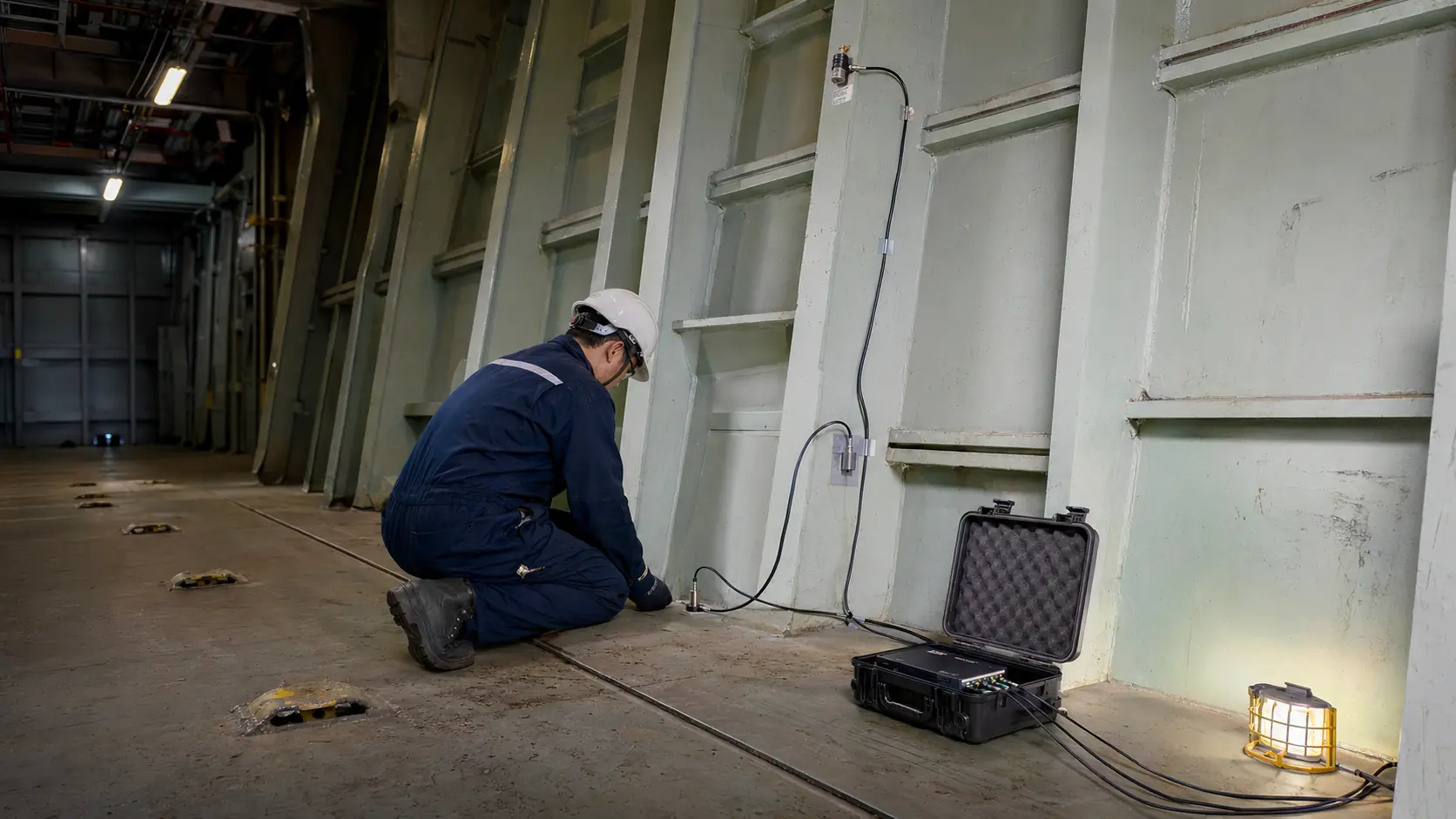
Vibration felt across a deck, superstructure or accommodation block may originate from propulsion, machinery, hydrodynamic excitation or a local structural mode. Vessel Doctor maps vibration amplitude, direction and frequency across the affected structure to show how the response develops and where more detailed analysis or modification should focus.
VIBRATION SPECTRUMClear evidence→
VESSEL DOCTORStructural and Hull Vibration Survey
SURVEY PROFILEVibration & Dynamics
14/21
01
WHY THIS SURVEY MATTERS
Evidence before assumption.
Treating the nearest machine does not always solve a structural vibration problem. The structure may amplify a modest excitation when forcing frequency aligns with a natural frequency. A mapped operational survey helps separate source, transmission path and responding structure.
02
MEASUREMENT SCOPE
What we measure.
- ✓Global and local structural vibration
- ✓Deck, bulkhead, foundation and superstructure response
- ✓Amplitude and phase relationships where included
- ✓Frequency and order content
- ✓Response through vessel-speed or machinery-speed sweeps
- ✓Comparative behaviour under different machinery configurations
03
TIMING & APPLICATION
When to request it.
Shaking decks, railings, panels or accommodation areas
Cracking, repeated fastening problems or fatigue concern
After structural, propulsion or machinery changes
Newbuilding trial anomalies
Before defining reinforcement or isolation work
04
SURVEY PROCESS
A controlled route from plan to finding.
Define
Confirm the decision, vessel condition and evaluation basis.
Prepare
Agree locations, safe access, instruments and operating matrix.
Measure
Capture traceable data with conditions documented during measurement.
Interpret
Evaluate against the agreed basis and isolate meaningful patterns.
Report
Issue findings, limitations and focused next actions.
05
TECHNICAL DELIVERABLE
What you receive.
- ✓Structural measurement grid
- ✓Operating and speed-sweep record
- ✓Vibration maps and spectra
- ✓Dominant frequency/order identification
- ✓Source-path-response interpretation
- ✓Recommendations for modal analysis, engineering calculation or corrective trials
06
STANDARDS & PROJECT CRITERIA
The governing basis comes first.
Use ISO 20283-2 for propulsion-excited structural vibration where applicable, relevant class rules, project specifications and engineering criteria appropriate to the structure and purpose. Do not use habitability values as structural integrity limits.
Important
Explore our standards directory↗Acceptance remains subject to the applicable flag administration, classification society, contract, vessel specification and authorised reviewing party.
ASIA + WORLDWIDE ATTENDANCE
Structural and Hull Vibration Survey wherever the vessel needs it.
Vessel Doctor coordinates this service for vessels in Singapore, India, Malaysia, Sri Lanka, Indonesia, Thailand, wider Asian maritime centres and ports worldwide. The scope can support technical managers, marine superintendents, ship agents, owners, operators, shipyards and consultants who need documented onboard evidence.
How clients describe this need: Projects may be described as ship structural vibration survey, hull vibration measurement, vessel deck vibration test, resonance assessment and marine structural diagnostics. Clients may also report that the deck, hull, superstructure, foundation or accommodation block shakes strongly at a particular RPM or operating condition. Depending on the technical question, the attendance may involve structural testing, vibration mapping, measurement, speed-sweep monitoring, resonance analysis, assessment or troubleshooting during sea trials, delivery testing, after propulsion or structural changes, in dry dock or during an in-service investigation. We confirm the final scope from the vessel, operating condition, access, applicable criteria, measurement purpose and required reporting outcome.
Southeast AsiaStructural and Hull Vibration Survey in Singapore↗South AsiaStructural and Hull Vibration Survey in India↗Southeast AsiaStructural and Hull Vibration Survey in Malaysia↗South AsiaStructural and Hull Vibration Survey in Sri Lanka↗Southeast AsiaStructural and Hull Vibration Survey in Indonesia↗Southeast AsiaStructural and Hull Vibration Survey in Thailand↗Global coverageWorldwide Structural and Hull Vibration Survey↗
SERVICE FAQ
Questions project teams ask.
Every scope is confirmed against the actual vessel, timing and decision requirement.
01Can a structural survey identify resonance?+
It can identify response peaks and frequency relationships consistent with resonance. Confirmation may require modal testing or calculation.
02Is high vibration always a structural-strength problem?+
No. Comfort or equipment issues can occur well below structural damage levels; the applicable assessment basis must be defined.
03Why measure several locations at once?+
Spatial and phase relationships help reveal how the structure moves and distinguish local from global response.
04Can you recommend reinforcement?+
We can identify target areas and diagnostic evidence. Final structural design should be completed and approved by a qualified naval architect/engineer and class where applicable.
STRUCTURAL VIBRATION DIAGNOSTICS
Separate the forcing source from the structure that responds.
Marine structural vibration testing, hull vibration measurement and shipboard resonance analysis must connect the complaint to operating speed, forcing order, response shape and transmission path. A high reading alone cannot show whether the source is propeller excitation, machinery, shaftline, a flexible panel, a foundation or a local resonance.
Map the symptom
Record the affected deck, bulkhead, superstructure, foundation or accommodation space, direction, onset RPM, loading condition and recent repair or retrofit.
Control the operating sweep
Plan steady holds, run-up or run-down points, machinery combinations and navigation conditions so amplitude and phase can be compared against RPM and forcing order.
Build a response map
Use simultaneous reference and response channels, three-axis points where useful, spectra, time histories, phase or operational deflection information and documented sensor mounting.
Test the diagnosis
Distinguish source correction, balancing/alignment investigation, stiffness or damping review, isolation changes and the additional evidence needed before modification.
| Observed vessel problem | Measurement plan | Decision boundary |
|---|---|---|
| Hull, deck or cabin shakes strongly at one RPM | Controlled speed sweep with tachometer/order reference, response points across the affected structure and comparison with propeller and machinery orders. | A peak near an order suggests correlation; resonance and root cause still require supporting evidence. |
| Vibration appeared after repair, retrofit or machinery change | Compare before/after configuration, supports, foundations, alignment state, mass or stiffness changes, isolators and the same operating condition where possible. | Do not attribute causation from timing alone. |
| One bulkhead, panel or deckhead rattles | Local response mapping, attachment and boundary inspection, impact/modal screening when appropriate, and simultaneous reference measurements. | A local panel response may be a receiver of remote forcing rather than the primary source. |
| Superstructure or accommodation vibration during sea trial | Multi-location, multi-direction survey across agreed trial points with vessel speed, shaft RPM, propeller condition, heading, sea state, loading and machinery status recorded. | Acceptance depends on the agreed contract, standard, class notation and operating tolerances. |
| Continuous in-service vibration concern | Trend repeatable points and operating states; use targeted structural diagnostics when trends or crew complaints indicate a location-specific response. | Condition monitoring and structural resonance investigation answer different questions. |
What to send before attendance
Provide vessel particulars, general arrangement and structural drawings, affected locations, video or crew description, triggering RPM or load, machinery and propeller details, recent modifications, previous measurements, trial window, loading condition, safe access and the decision the report must support. The deliverable can document measurement locations, equipment and calibration status, sensor mounting, operating log, spectra, orders, phase relationships, response maps, limitations and recommended confirmation work.
Class, flag and mobilisation context
For ABS-, BV-, CCS-, CRS-, DNV-, IRS-, KR-, LR-, ClassNK-, PRS-, RINA- or Türk Loydu-classed vessels, the required method and report acceptance depend on notation, contract, flag and attending surveyor. Work can be planned at berth, anchorage, harbour trial, sea trial, shipyard, dry dock or in service in Singapore, Malaysia, India, Sri Lanka, Indonesia, Thailand, the Philippines, the Middle East, Asia-Pacific or worldwide, subject to operating access. No class or flag approval is claimed.
START A TECHNICAL DISCUSSION
Plan your structural and hull vibration survey.
Share the vessel, location, operating condition and reporting purpose. We will help shape a focused, technically defensible survey scope.