
Newbuilding or conversion acceptance
Noise & Acoustics · SERVICE 13
PA/GA Audibility and Speech Intelligibility Survey
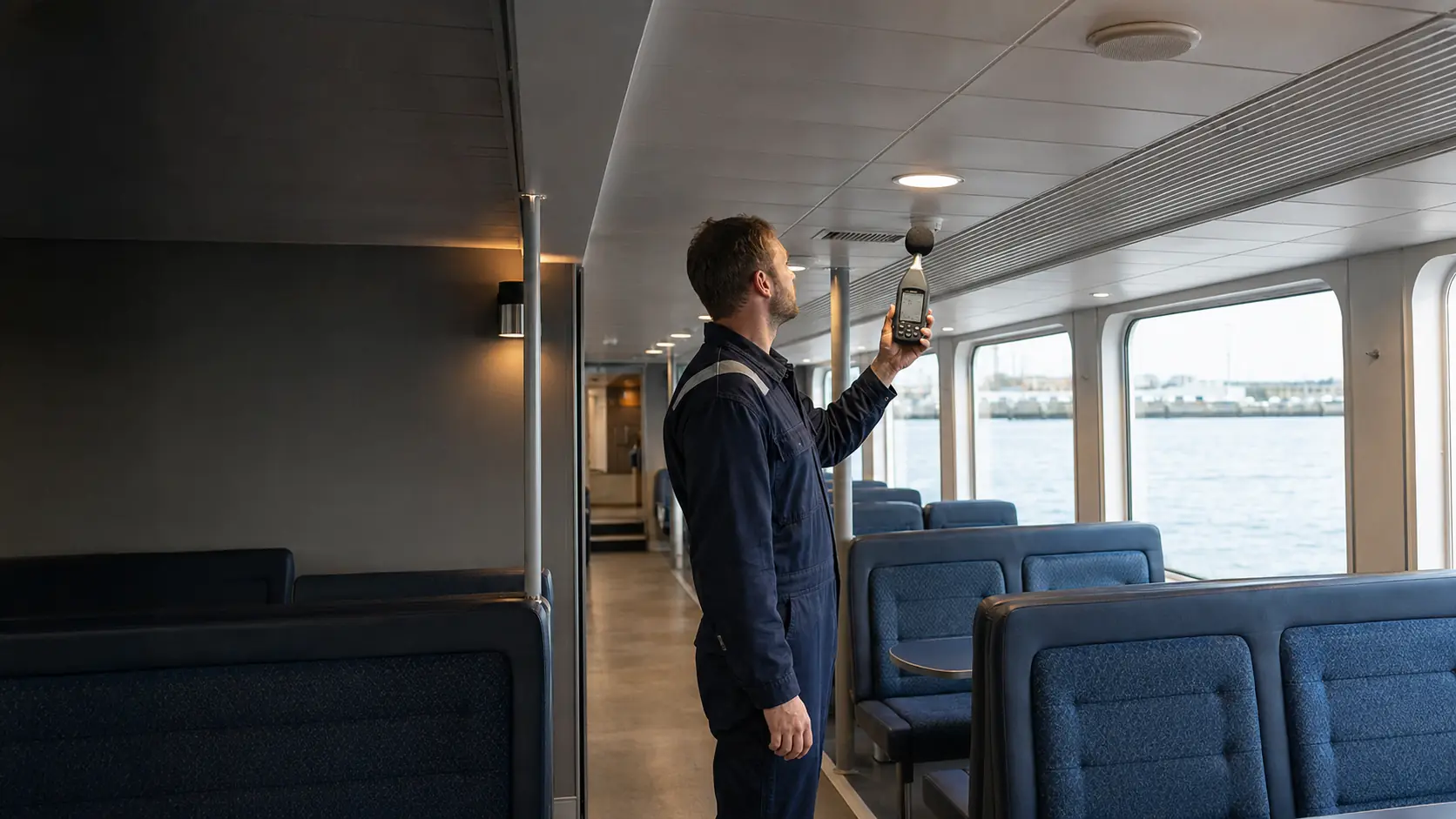
An emergency message must be heard, recognised and understood in the spaces where people may be located. Vessel Doctor measures public-address and general-alarm performance across representative onboard locations, including areas where machinery, ventilation, weather or occupational noise may mask the signal.
ACOUSTIC FIELD MAPPINGClear evidence→
VESSEL DOCTORPA/GA Audibility and Speech Intelligibility Survey
SURVEY PROFILENoise & Acoustics
13/21
01
WHY THIS SURVEY MATTERS
Evidence before assumption.
Electrical operation alone does not prove acoustic effectiveness. Speaker placement, orientation, level balance, reverberation, background noise and language clarity all influence whether an instruction reaches the listener.
02
MEASUREMENT SCOPE
What we measure.
- ✓Background noise at test locations
- ✓PA announcement level and signal-to-noise relationship
- ✓General-alarm level and coverage
- ✓Speech intelligibility using the agreed method
- ✓Coverage in cabins, corridors, public rooms, machinery spaces and open decks
- ✓Dead zones, excessive level variation and masking
03
TIMING & APPLICATION
When to request it.
After speaker, amplifier or cabling modifications
Following audibility complaints
After machinery or HVAC noise changes
During safety-system verification
To develop a corrective speaker or zoning plan
04
SURVEY PROCESS
A controlled route from plan to finding.
Define
Confirm the decision, vessel condition and evaluation basis.
Prepare
Agree locations, safe access, instruments and operating matrix.
Measure
Capture traceable data with conditions documented during measurement.
Interpret
Evaluate against the agreed basis and isolate meaningful patterns.
Report
Issue findings, limitations and focused next actions.
05
TECHNICAL DELIVERABLE
What you receive.
- ✓Test-location and system-operation schedule
- ✓Background, PA and alarm results
- ✓Speech-intelligibility results where included
- ✓Coverage map and deficient locations
- ✓System-level and acoustic observations
- ✓Corrective recommendations and retest priorities
06
STANDARDS & PROJECT CRITERIA
The governing basis comes first.
Use applicable SOLAS/IMO public-address and alarm requirements, flag/class rules, vessel specifications and IEC 60268-16 when STI-based speech-intelligibility testing is agreed. Confirm test signal, announcement source, zoning and operating condition before testing. Do not imply that IMO resolution A.1021(26) alone defines every PA acceptance limit.
Important
Explore our standards directory↗Acceptance remains subject to the applicable flag administration, classification society, contract, vessel specification and authorised reviewing party.
ASIA + WORLDWIDE ATTENDANCE
PA/GA Audibility and Speech Intelligibility Survey wherever the vessel needs it.
Vessel Doctor coordinates this service for vessels in Singapore, India, Malaysia, Sri Lanka, Indonesia, Thailand, wider Asian maritime centres and ports worldwide. The scope can support technical managers, marine superintendents, ship agents, owners, operators, shipyards and consultants who need documented onboard evidence.
How clients describe this need: Projects may be described as ship PA/GA audibility survey, vessel public-address test, general-alarm measurement and speech-intelligibility assessment. Clients may also report that alarms or announcements cannot be heard clearly or understood in cabins, machinery spaces, public rooms or open decks. Depending on the technical question, the attendance may involve audibility testing, sound-level measurement, coverage survey, speech-intelligibility testing, assessment or troubleshooting during newbuilding acceptance, safety-system commissioning, sea trials, post-modification verification or an in-service complaint investigation. We confirm the final scope from the vessel, operating condition, access, applicable criteria, measurement purpose and required reporting outcome.
Southeast AsiaPA/GA Audibility and Speech Intelligibility Survey in Singapore↗South AsiaPA/GA Audibility and Speech Intelligibility Survey in India↗Southeast AsiaPA/GA Audibility and Speech Intelligibility Survey in Malaysia↗South AsiaPA/GA Audibility and Speech Intelligibility Survey in Sri Lanka↗Southeast AsiaPA/GA Audibility and Speech Intelligibility Survey in Indonesia↗Southeast AsiaPA/GA Audibility and Speech Intelligibility Survey in Thailand↗Global coverageWorldwide PA/GA Audibility and Speech Intelligibility Survey↗
SERVICE FAQ
Questions project teams ask.
Every scope is confirmed against the actual vessel, timing and decision requirement.
01What is the difference between audibility and intelligibility?+
Audibility means the signal can be heard; intelligibility means spoken information can be understood.
02Must machinery be running?+
Testing should represent the background-noise condition required by the governing rule or acceptance specification.
03Can more speaker volume fix every failure?+
No. Excessive volume can reduce clarity and create uneven coverage. Location, directivity, reverberation and zoning may be more important.
04Can open-deck areas be tested?+
Yes, when safe and when weather and operational conditions are documented.
START A TECHNICAL DISCUSSION
Plan your pa/ga audibility and speech intelligibility survey.
Share the vessel, location, operating condition and reporting purpose. We will help shape a focused, technically defensible survey scope.
PA/GA TEST DECISION PLAN
Prove that the alarm is heard and the message is understood.
A ship PA/GA test should answer two different questions: is the general alarm or announcement audible above the representative background, and can spoken safety information be understood at the listening positions that matter?
Freeze the test state
Record amplifier, zone, speaker, microphone or message source, doors, ventilation, machinery, vessel activity and any temporary isolations before readings begin.
Select receiver positions
Cover representative cabins, corridors, public rooms, machinery spaces, control stations, open decks and local masking or dead-zone complaints.
Separate audibility and clarity
Capture background and alarm or announcement levels. Add an agreed STI/STIPA or other intelligibility method when understanding speech is part of the decision.
Find the controlling cause
Distinguish low signal level, uneven coverage, masking, reverberation, distortion, zoning or source-path problems before recommending adjustment and retest.
| Buyer or crew report | Measurement scope | Useful output |
|---|---|---|
| The ship alarm cannot be heard in one area | Representative background and alarm sound-level measurements, location map, system zone and operating-state record. | Audibility margin or agreed comparison, deficient positions and targeted retest plan. |
| The announcement is loud but words are unclear | Speech-intelligibility testing across the complete agreed signal path, plus background, level distribution and room-response observations. | STI/STIPA or agreed metric, limiting factors and corrective priorities. |
| Coverage changed after retrofit or speaker work | Before/after or commissioning survey across affected and neighbouring zones under comparable conditions. | Coverage comparison, exceptions, configuration record and verification status. |
| Newbuilding, harbour-trial or sea-trial acceptance | Test schedule tied to approved drawings, specification, operating matrix and the reviewing party's agreed basis. | Traceable location results, configuration, limitations and submission-ready evidence. |
Classed-vessel and flag-review context
For ABS-, DNV-, Lloyd's Register-, Bureau Veritas-, RINA-, ClassNK- or other classed vessels, and for Singapore-, Panama-, Liberia-, Marshall Islands-, Bahamas-, Malta-, Cyprus-, Hong Kong- or Isle of Man-flagged ships, confirm the governing rule, approved plan, test purpose, operating state, supplier qualification and witnessing or submission route before attendance. Ordinary troubleshooting, project acceptance and a formal class or statutory survey are not automatically the same scope. This wording does not claim society or flag approval. Review the standards directory.
Technical planning guide: Read the PA/GA commissioning and acceptance test plan.